Hearing that a bone has broken into several pieces can be worrying. You might wonder whether all those fragments can be put back together, whether you'll need metal plates or rods, and how long the injury will take to heal.
A complex bone fracture can involve far more than the visible breaks on an X-ray. Sometimes, the surrounding muscles and blood vessels are also injured. In other cases, small pieces of bone have shifted so much that maintaining the original shape becomes difficult.
Doctors call a break involving three or more bone fragments a comminuted fracture.
These injuries are not all treated in the same way. Some can heal with appropriate immobilisation, while others require surgery to restore alignment and provide stability.
The aim isn't necessarily to attach every small piece individually. It's to help the bone heal in a position that supports normal function.
How Is a Complex Bone Fracture Repaired?
A bone broken into several pieces may be treated with a cast, brace or surgery, depending on its alignment, stability and the extent of surrounding tissue damage. When surgery is needed, the surgeon may use plates, screws, rods or other fixation methods to hold the important bone segments in an appropriate position while healing takes place.
The treatment plan generally considers:
- Alignment: Whether the bone has become shortened, bent or twisted.
- Stability: Whether the fragments can remain in position during healing.
- Blood supply: Whether the injured bone and surrounding tissues have adequate circulation.
- Soft-tissue condition: Whether muscles, skin, nerves or blood vessels have been damaged.
- Bone loss: Whether any bone is missing or too damaged to remain viable.
- Joint involvement: Whether the fracture extends into a joint surface.
Patients and families seeking information about how different bone fractures are assessed and treated can review the available approaches before discussing an individual injury with an orthopaedic specialist.
The challenge is not simply the number of broken pieces. Where those pieces are located—and whether the surrounding tissues can support healing—often matters more.
What Makes a Shattered Bone Different From an Ordinary Fracture?
Consider a bone that breaks cleanly into two main pieces.
If the position is suitable and the fragments remain stable, treatment may be relatively straightforward. Depending on the bone and fracture pattern, a cast, brace or surgical fixation might be appropriate.
Now consider a bone broken into several irregular fragments.
Some pieces may be displaced. Others may remain attached to muscle or connective tissue. The bone might also have lost its normal length or rotational alignment.
This makes reconstruction more demanding.
Simple Fracture vs Shattered Bone Fracture
| Feature | Simple fracture pattern | Comminuted fracture |
|---|---|---|
| Bone fragments | Usually two main pieces | Three or more pieces |
| Alignment | May be easier to restore | Often more difficult |
| Stability | Sometimes achievable with immobilisation | Unstable patterns may need surgical fixation |
| Blood supply | Depends on injury severity | Can be affected by fragmentation and tissue damage |
| Treatment planning | Depends on displacement and location | May require more detailed reconstruction planning |
| Healing concerns | Vary with the injury | May increase when circulation or stability is compromised |
The number of fragments alone does not determine whether surgery is necessary.
A fracture with several small but well-aligned pieces may sometimes heal without surgery. A fracture with only two pieces may still require an operation if it is unstable, significantly displaced or involves an important joint surface.
Why Can't Surgeons Simply Put Every Bone Fragment Back Together?
It might seem logical that the best operation would involve collecting every broken piece, returning it to its original position and fixing it securely.
But a living bone is different from a broken object.
Bone fragments need a blood supply to heal. Some small pieces remain connected to surrounding muscles and soft tissues through delicate attachments that carry blood vessels.
If those fragments are repeatedly moved or stripped away from their attachments, the biological conditions needed for healing may be damaged.
That creates an important surgical decision.
In some multi-piece fractures, the surgeon may restore the position of the larger bone segments while leaving smaller fragments relatively undisturbed.
The surrounding tissues then remain better preserved, allowing new bone to form across the fracture region.
This principle is used in selected procedures known as bridge fixation.
It is particularly relevant to certain long-bone shaft fractures, although it is not suitable for every injury.
When a fracture extends into a joint, for example, restoring the smooth joint surface may require a more precise reconstruction.
The surgical goal is to balance mechanical stability with preservation of the bone's healing potential.
How Do Plates and Screws Help a Shattered Bone Heal?
A common concern is whether a metal plate can hold a bone together when several fragments are present.
In selected cases, it can.
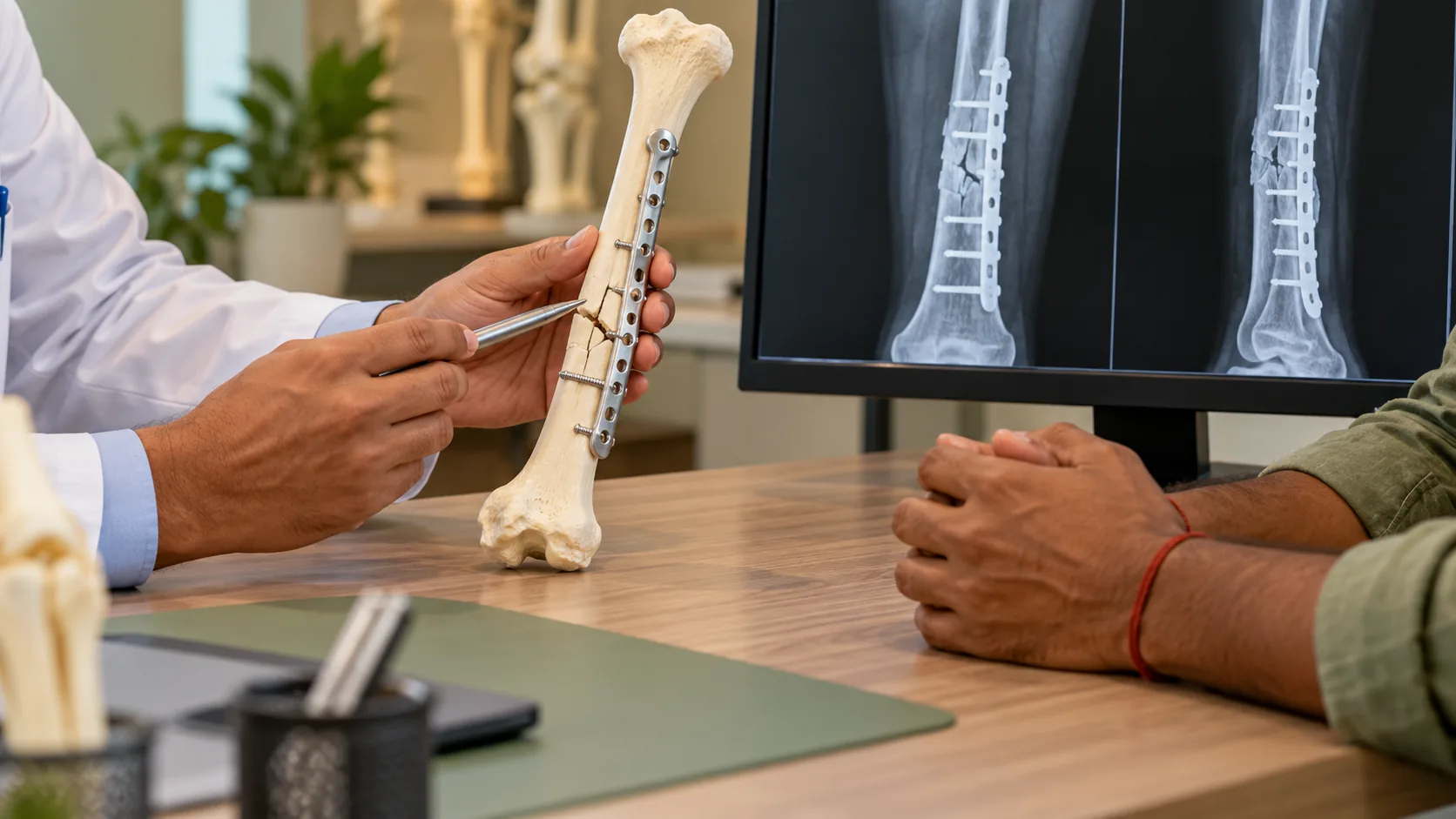
A surgical plate is attached to the bone using screws. Its role is to maintain the required alignment and provide mechanical support while healing progresses.
However, surgeons do not always place screws into every broken fragment.
Why bridge plating may be used
Imagine a thighbone or upper-arm bone with several small fragments between two larger sections.
Trying to fix every intermediate piece might require extensive surgical exposure and disruption of the surrounding tissues.
With bridge plating, a plate can span the fragmented area and support the main bone segments.
The smaller fragments may remain within the fracture zone, retaining their natural tissue attachments.
The AO Surgery Reference guidance on bridge plating describes this approach for suitable multifragmentary shaft fractures, where preserving the surrounding tissues supports healing.
This technique is not appropriate for every comminuted fracture. The location of the injury, the required stability and any damaged joint surface can change the fixation strategy.
When individual fragments need precise fixation
If a fracture affects the smooth surface of a joint, small differences in alignment can influence movement and joint function.
The surgeon may therefore need to restore the important joint fragments more precisely and secure them using screws, plates or other suitable fixation methods.
A complex wrist fracture is one example where joint-surface alignment can be especially relevant.
The treatment plan must account for both the bone and the joint it supports.
Plates, Rods or External Frames: Why Does the Fixation Method Differ?
Not every broken bone is best treated with a plate.
Different implants provide stability in different ways.
Plates and screws are commonly used when the fracture requires a particular type of alignment control or when its location makes plating suitable.
Intramedullary nails are metal rods placed inside the central canal of certain long bones, such as the thighbone or shinbone. They may be suitable for some fragmented shaft fractures because they support the main bone segments internally.
External fixators use pins placed into the bone and connected to a frame outside the limb. They may be used temporarily after severe injuries or as definitive treatment in selected circumstances.
The selection depends on several clinical considerations, including the fracture pattern, the condition of the soft tissues and whether the patient has other serious injuries.
For instance, a person involved in a major road accident may have substantial swelling or open wounds around the fracture. The surgeon may decide that temporary stabilisation is safer before further reconstruction.
A patient with a closed fracture and relatively healthy surrounding tissues may be suitable for definitive fixation during an earlier operation.
Neither approach is automatically better. They address different injury circumstances.
Why Does the Blood Supply Matter So Much?
A bone needs more than a metal implant to heal.
It also needs adequate blood circulation.
Blood carries oxygen and other substances involved in tissue repair. After a fracture, the body begins forming new tissue around the damaged area, gradually creating a bridge between the fragments.
Severe injuries can disrupt this process.
A high-energy impact may damage the vessels supplying the bone. Open wounds, crushed muscles or extensive surgical disruption can further complicate healing.
Surgeons therefore assess both the fracture and the condition of the surrounding tissues.
Sometimes the safest reconstruction is one that restores the overall shape of the bone without unnecessarily exposing every fragment.
That approach reflects an important principle of modern fracture care: preserve the tissues that help the bone heal while providing the stability it needs.
What Happens When Part of the Bone Is Missing?
Not every shattered fracture involves actual bone loss.
In many cases, the fragments are still present, even if they have moved away from their normal positions.
Bone loss becomes a separate concern when some tissue is missing, severely damaged or must be removed because it is contaminated or no longer viable.
This can leave a gap between the healthy bone ends.
A substantial gap may be difficult for the body to bridge without additional treatment.
Depending on the injury, surgeons may consider bone grafting or staged reconstructive procedures.
Bone grafting involves placing suitable bone material in an area where additional support for healing is needed. Other reconstruction techniques may be considered for larger defects.
These procedures are not automatically required simply because an X-ray shows several fragments.
The decision depends on the size and location of the defect, blood supply, infection risk and the stability of the reconstructed bone.
Why Are Open Fractures More Complicated?
An open fracture occurs when a broken bone is associated with a wound that communicates with the fracture site.
The bone does not necessarily have to be visible through the skin.
Even a relatively small wound can create a route for bacteria to enter damaged tissues.
This increases concerns about infection and may require urgent surgical cleaning, antibiotics, stabilisation and careful wound management.
An open fracture can also involve damage to muscles, nerves and blood vessels.
The American Academy of Orthopaedic Surgeons' guidance on open fractures explains why prompt medical treatment and attention to contaminated tissues are essential.
For some severe injuries, treatment may be performed in stages. Initial care focuses on managing the wound and stabilising the limb, while further reconstruction follows when clinically appropriate.
An open fracture is a medical emergency. Anyone with a suspected fracture and an associated open wound should seek emergency assessment rather than wait for a routine consultation.
How Do Doctors Plan Surgery for a Bone Broken Into Several Pieces?
Before deciding which implant to use, the medical team needs a clear picture of the injury.
X-rays usually provide the initial information about where the bone has broken and how the fragments are positioned.
A CT scan may be needed when the fracture pattern is difficult to understand or when the injury extends into a joint.
The surgeon also examines circulation, sensation, movement and the condition of the surrounding skin and muscles.
A patient with a wrist fracture involving several joint fragments may need a very different operation from someone with a fragmented thighbone shaft.
The wrist may require detailed reconstruction of the joint surface.
A long-bone shaft fracture may instead require restoration of overall length, alignment and rotation, with fixation that preserves the intermediate fragments.
These differences explain why two patients with shattered bones may receive different surgical recommendations.
The operation is planned around the injury's mechanical and biological requirements—not simply how dramatic the X-ray appears.
Can a Bone Broken Into Several Pieces Heal Normally?
Many complex fractures can heal, but recovery varies considerably.
The injured bone, severity of fragmentation, surrounding tissue damage and stability of treatment all affect the healing process.
A fracture may heal more slowly when blood supply is compromised or when the bone cannot be held in an appropriate position.
Certain health conditions, infection, tobacco use and inadequate nutrition can also affect recovery.
Doctors monitor several potential complications.
Delayed union means the bone is healing more slowly than expected.
Nonunion means the fracture has failed to heal adequately.
Malunion means the bone has healed in an unsuitable position, potentially causing deformity or functional problems.
The risk of these outcomes varies from patient to patient.
Follow-up examinations and imaging help assess whether the bone is healing and whether its alignment remains acceptable.
Rehabilitation also matters. Depending on the injury, patients may need temporary restrictions on lifting, walking or weight-bearing before gradually rebuilding movement and strength.
Some injuries require months of recovery. Others take longer, particularly when severe tissue damage or additional reconstruction is involved.
No surgeon can accurately promise the same recovery timeline for every multi-piece fracture.
When Should You Seek Specialist Fracture Care in Kolkata?
A suspected fracture should be assessed promptly, particularly after a road accident, significant fall or other substantial injury.
Severe pain, visible deformity, inability to bear weight or difficulty moving the affected limb may indicate a serious injury.
Immediate emergency care is particularly important when there is an open wound, uncontrolled bleeding, numbness, a cold or pale hand or foot, or rapidly worsening pain and swelling.
Do not attempt to straighten a badly deformed limb yourself. Avoid unnecessary movement and arrange safe emergency transport.
Once the immediate injury has been assessed and stabilised, an orthopaedic specialist can review the fracture pattern, treatment options and rehabilitation requirements.
Dr. Manoj Kumar Khemani is an orthopaedic surgeon associated with HealMyBones in Kolkata, where information about fracture assessment and treatment is available.
Patients researching fracture surgery or treatment for complex injuries should understand whether their particular fracture requires immobilisation, internal fixation, staged treatment or additional reconstruction.
For a serious new injury, the nearest appropriate emergency facility should take priority over a scheduled outpatient appointment.
A Shattered Bone Needs More Than the Right Implant
When a bone breaks into several pieces, the surgeon's work involves more than deciding where to place screws or a plate.
The fragments must be supported in an appropriate position. The surrounding tissues need protection. And the treatment must create conditions that allow living bone to heal.
Sometimes, that means reconstructing important fragments individually. At other times, leaving smaller pieces attached to their natural tissues is part of the surgical strategy.
The most useful next step for a patient is to understand the specific fracture pattern, why a particular treatment has been recommended and what recovery will involve.
If you or a family member has sustained a complicated fracture, seek timely assessment from a qualified orthopaedic professional. Treatment decisions should be based on the injury and clinical findings, not simply the number of pieces shown on an X-ray.
Frequently Asked Questions (FAQs)
1. Can a bone broken into several pieces heal completely?
Yes, many bones broken into several pieces can heal successfully with appropriate treatment. Healing depends on the fracture's location, stability, blood supply, surrounding tissue damage and the patient's overall health. Some complicated fractures require surgery or additional procedures, and complete recovery cannot be guaranteed.
2. Does a comminuted fracture always require surgery?
No, a comminuted fracture does not always require surgery. A cast or brace may be sufficient when the fracture is stable and the bone fragments remain acceptably aligned. Surgery may be recommended when there is significant displacement, instability, joint involvement or serious soft-tissue injury.
3. How do surgeons repair a bone that has shattered into several pieces?
Surgeons may use plates, screws, metal rods or external fixation devices to stabilise a shattered bone. The chosen method depends on the fracture pattern, location, bone quality and condition of nearby tissues. In some cases, smaller fragments are deliberately left attached to surrounding tissues to preserve their blood supply during healing.
4. How long does it take for a comminuted fracture to heal?
A comminuted fracture often requires several months for healing and functional recovery, although the exact timeline varies considerably. Severe fragmentation, poor blood supply, infection or other health conditions may delay healing. Regular follow-up examinations and X-rays help determine when activities and weight-bearing can safely increase.
5. Are plates and screws permanently left inside the bone?
Plates and screws are often left in place after the fracture has healed if they are not causing problems. Removal may be considered when implants cause persistent irritation, infection or other complications, but another operation carries its own risks. The treating surgeon can explain whether removal is appropriate after assessing the healed bone.
6. What happens if the broken bone fragments do not heal properly?
A complex fracture may develop delayed union, nonunion or malunion. These conditions mean that healing is unusually slow, the bone fails to unite adequately, or it heals in an unsuitable position. Further treatment may involve reassessment of alignment, stability, infection risk and whether additional surgery is necessary.
7. Can a comminuted fracture cause permanent disability?
Some severe comminuted fractures can result in lasting stiffness, weakness, reduced movement or other functional limitations. The risk is influenced by the injured bone, joint involvement, nerve damage, soft-tissue injury and complications during healing. Timely treatment and appropriate rehabilitation can support recovery, although they cannot guarantee full restoration of function.
8. When should someone with a shattered bone seek emergency medical care?
A suspected shattered bone should receive prompt medical evaluation, particularly after a serious accident or fall. An open wound near the fracture, uncontrolled bleeding, a cold or pale limb, new numbness, severe deformity or rapidly worsening pain requires emergency attention. Avoid moving or straightening the injured area unnecessarily and seek care at an appropriate emergency facility.
Medical Disclaimer
This article is intended for general educational purposes and should not be considered individual medical advice, diagnosis or a recommendation for any specific surgical procedure.
Fracture treatment depends on the injured bone, severity of the injury, imaging findings, soft-tissue condition and overall health. Surgery and non-surgical treatment both carry potential risks, and successful healing or recovery cannot be guaranteed.
Seek immediate emergency care for suspected open fractures, uncontrolled bleeding, loss of circulation, new numbness or severe worsening pain. Do not delay emergency treatment based on information in this article.