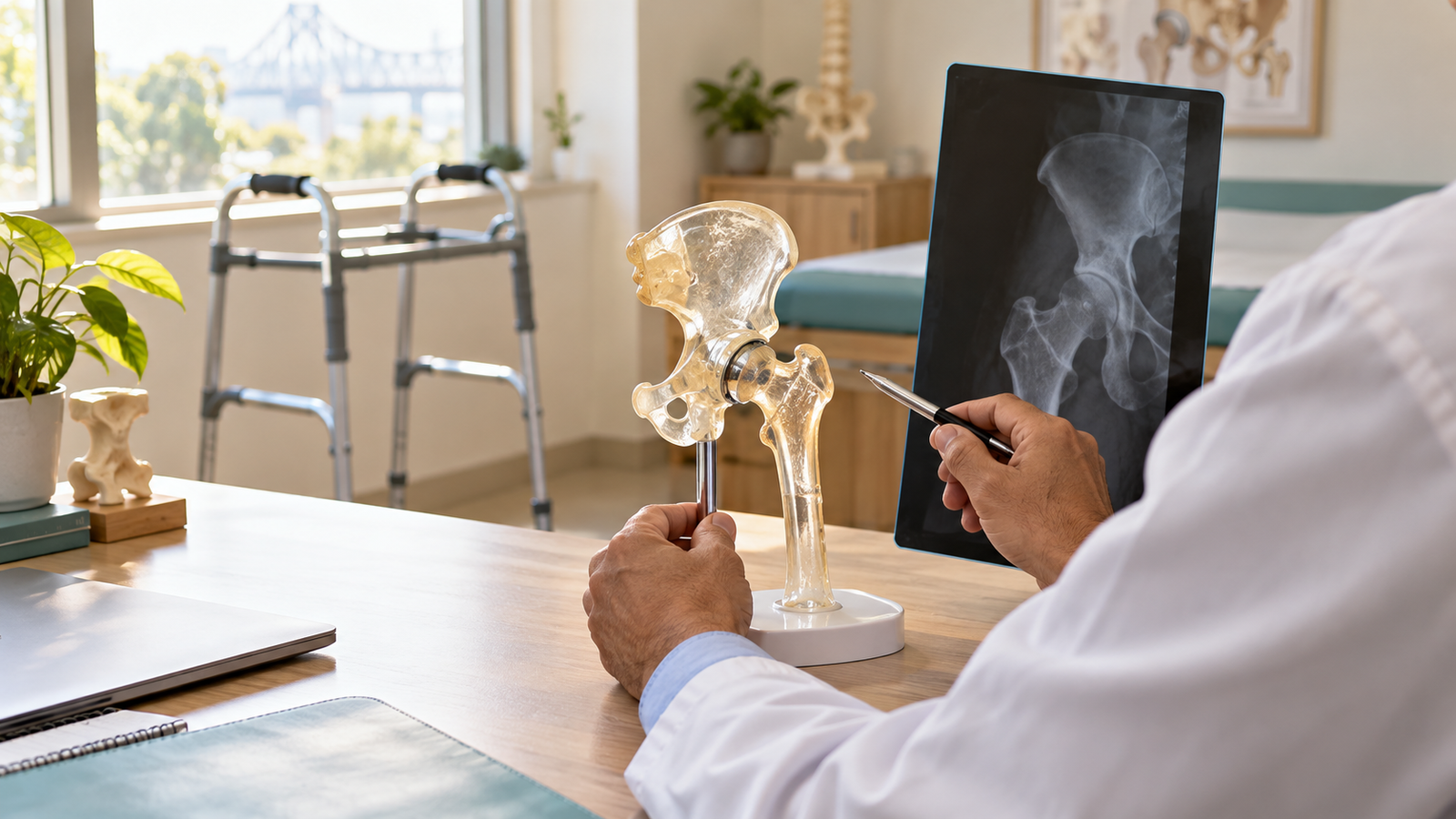
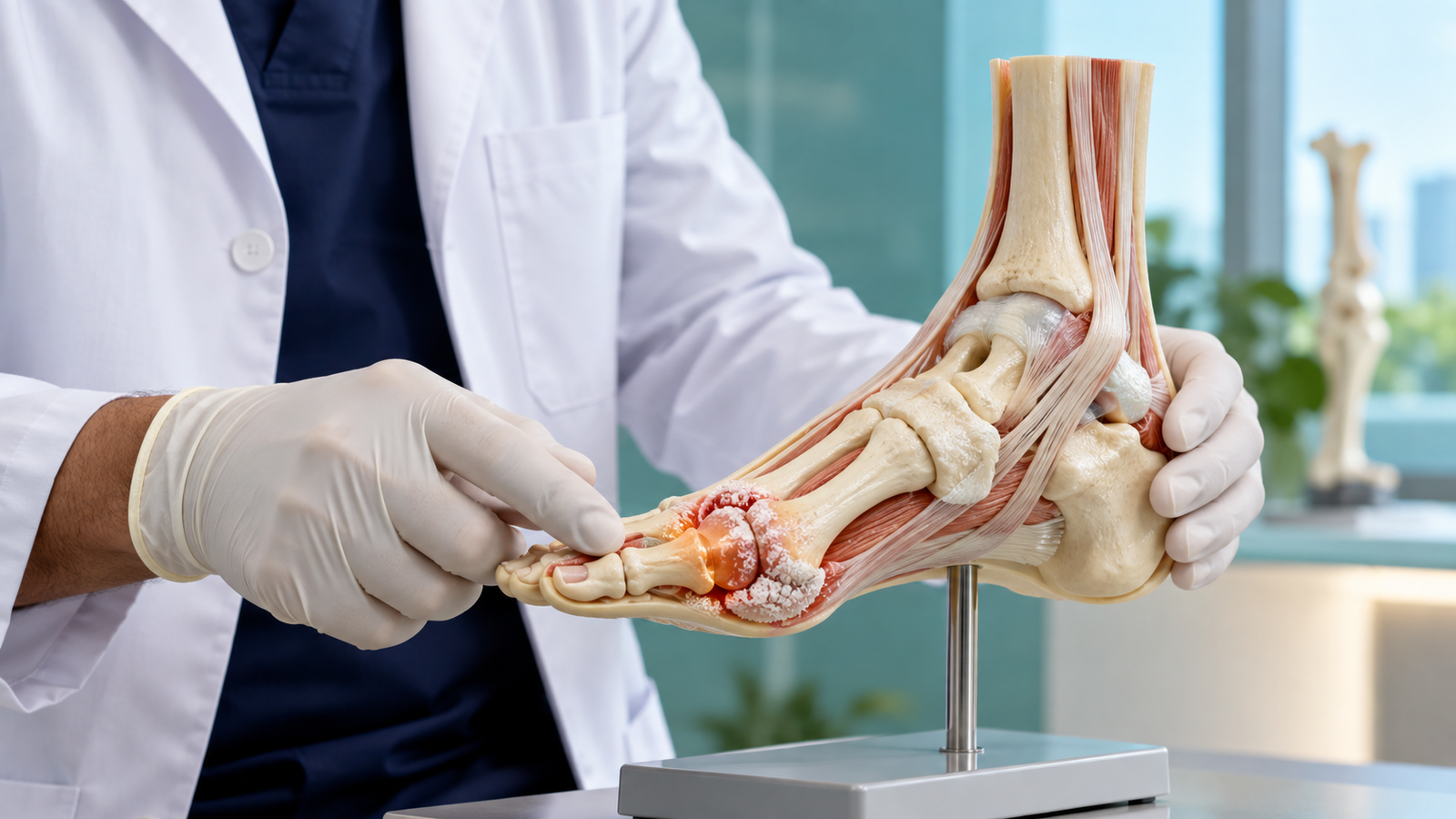
Gout is usually managed medically. Most patients first need a physician, rheumatologist, or uric acid specialist doctor to assess uric acid levels, repeated flares, kidney health, lifestyle factors, and long-term medical control.
But gout is not always limited to sudden pain and swelling.
When repeated attacks start affecting cartilage, bone, joint shape, walking, or daily movement, orthopedic evaluation may become part of the treatment plan. For patients looking for gout treatment in Kolkata, the key question is not only, “How do I reduce uric acid?” It is also, “Has gout started damaging the joint?”
When does gout-related joint damage need orthopedic attention?
Gout may need orthopedic review when it starts creating structural problems inside or around a joint. This does not replace medical gout care. It adds a joint-focused assessment when pain, stiffness, deformity, tophi, or walking difficulty begins affecting function.
Patients with gout-related swelling, stiffness, tophi, deformity, walking difficulty, or suspected cartilage and bone damage may benefit from gout-related joint evaluation in Kolkata, especially when the concern is no longer only the uric acid report but how the joint is actually moving and bearing weight.
| Joint concern | Why orthopedic review may matter |
|---|---|
| Repeated swelling | To check whether the joint is being structurally affected |
| Tophi around joints | To assess pressure, deformity, skin risk, or tendon involvement |
| Stiffness | To evaluate cartilage, bone, and joint movement |
| Deformity | To check alignment and functional damage |
| Walking difficulty | To assess weight-bearing joints such as the foot, ankle, knee, or hip |
| Bone or cartilage damage | To understand whether structural treatment is needed |
| Severe swelling that mimics infection | To avoid missing urgent joint conditions |
CDC explains that gout develops when excess uric acid leads to crystals forming in a joint, which can cause severe pain and swelling. Patients can read the CDC overview on gout and arthritis for a neutral public-health reference.
The real patient concern: “Is this still only a uric acid problem?”
This is where many patients become unsure.
At first, gout may feel like an occasional attack. The big toe swells. The ankle hurts. The knee becomes hot and painful. The flare settles, and life moves on.
Then something changes.
The joint stays thick. The toe looks bent. The ankle feels stiff. The knee does not bend the way it used to. Walking becomes painful even between attacks. A lump appears near the joint. Shoes feel tight. Family members notice a limp.
That is when the joint itself needs to be looked at, not just the uric acid report.
A gout specialist doctor, physician, rheumatologist, and orthopedic surgeon may all have different roles. Medical care remains the foundation. Orthopedic review becomes relevant when gout seems to be affecting the joint’s shape, movement, strength, or daily function.
Can gout damage cartilage and bone?
Yes, long-standing or poorly controlled gout can damage joints in some patients.
During a gout attack, urate crystals trigger inflammation inside or around the joint. Repeated inflammation may irritate the joint lining and affect movement. Over time, gout can also be associated with cartilage damage, bone erosion, and loss of normal joint function.
NIAMS explains that gout happens when high urate levels form needle-shaped crystals in and around joints, and that tophi can become painful and may cause bone and soft-tissue damage as well as misshapen joints. Patients can review the NIAMS guide on gout symptoms and causes for more patient-level information.
This does not mean every person with gout will develop joint damage. Many patients manage gout well with proper medical care. But if the joint has changed shape, become stiff, or remains painful between flares, it should not be ignored.
What are tophi?
Tophi are deposits of urate crystals that may form under the skin or around joints in long-standing gout.
They may look like firm lumps near the toes, fingers, elbows, ankles, knees, or other areas. Some are painless at first. Others become painful, stretched, inflamed, or difficult to manage because they interfere with joint movement or press on nearby tissues.
Tophi can affect:
- shoe fitting
- hand grip
- walking balance
- tendon movement
- skin comfort
- joint flexibility
- bone and soft tissue around the joint
For patients searching uric acid arthritis treatment in Kolkata, visible lumps, changing joint shape, or increasing stiffness should be discussed clearly during consultation. The aim is not to rush into surgery. The aim is to understand whether the tophus is mainly a medical-control issue or whether it has created a structural joint problem.
When is surgery considered in gout?
Surgery is not the first-line treatment for most gout patients.
Gout is generally managed medically. Uric acid control, flare prevention, and long-term monitoring are usually handled by physicians or rheumatologists. Orthopedic surgery may be considered only in selected cases where gout has caused mechanical or structural problems.
Surgical review may be considered when:
- a tophus affects walking, footwear, or hand function
- the joint becomes severely stiff or deformed
- bone or cartilage damage causes persistent disability
- a tendon or soft tissue structure is affected
- skin over a tophus becomes fragile or repeatedly irritated
- joint destruction causes severe mechanical pain
- diagnosis is uncertain and infection or another condition must be ruled out
AAOS describes gout as a crystal-related form of inflammatory arthritis and notes that repeated gout attacks can lead to inflammatory arthritis in affected joints. Its patient resource on gout causes and treatments gives a useful orthopedic reference.
Why uric-acid management still matters even if surgery is discussed
Even when an orthopedic surgeon becomes involved, uric-acid management still matters.
Surgery cannot control the metabolic cause of gout. It may address a damaged joint, a painful tophus, deformity, stiffness, tendon involvement, or another mechanical complication. But if uric acid remains uncontrolled, gout can continue to affect the same joint or other joints.
The American College of Rheumatology guideline identifies tophaceous gout, radiographic joint damage due to gout, and frequent flares as important situations in gout management. Patients should discuss medical management with a qualified physician or rheumatologist rather than self-adjusting medicines.
This is why gout care is sometimes a team decision.
A physician or rheumatologist usually manages uric acid, flares, medicines, and related health risks. An orthopedic surgeon evaluates structural joint damage, deformity, walking difficulty, tendon involvement, and whether any surgical issue exists.
They solve different parts of the same problem.
When should patients in Kolkata seek orthopedic evaluation for gout?
Patients searching for a gout specialist doctor, uric acid specialist doctor Kolkata, or gout arthritis doctor Kolkata should first identify the main problem.
If the issue is repeated flare-ups, high uric acid, or medicine planning, medical care usually leads. If gout has caused tophi, joint stiffness, deformity, walking difficulty, suspected cartilage damage, or bone involvement, orthopedic evaluation may become part of the overall gout treatment plan.
A practical approach is this:
- For high uric acid, repeated flares, or medicine planning, start with a physician or rheumatologist.
- For joint deformity, stiffness, severe walking difficulty, damaged cartilage, tendon concern, or large tophi causing mechanical problems, orthopedic review may help.
- For sudden severe swelling with fever, wound, extreme tenderness, or inability to bear weight, urgent medical review is important because infection and other serious joint problems can mimic gout.
The right doctor depends on what the patient is actually facing.
Why Dr. Khemani’s orthopedic evaluation may be relevant
Gout becomes confusing when pain keeps returning or when the joint no longer looks or moves normally.
Dr. Manoj Kumar Khemani may be relevant for patients who need orthopedic assessment of gout-related joint damage, deformity, stiffness, tophi-related mechanical problems, or walking difficulty. Heal My Bones explains this topic because many patients are unsure whether they should see a gout doctor, uric acid specialist doctor, rheumatologist, or orthopedic surgeon.
The answer depends on the problem.
If the main issue is uric acid control, medical care leads. If the joint has started changing structurally, orthopedic evaluation can help clarify what has happened inside the joint and whether movement, alignment, or weight-bearing has been affected.
FAQ
Which doctor should I consult for uric acid?
For high uric acid, repeated gout flares, or medicine planning, many patients first consult a physician or rheumatologist. If gout has caused joint deformity, stiffness, tophi-related mechanical problems, cartilage damage, or walking difficulty, an orthopedic surgeon may also become part of the treatment team.
Can gout be cured permanently?
Gout is a long-term metabolic condition that can often be controlled well with proper medical care and monitoring. Patients should avoid self-treatment or stopping medicines without medical advice. If gout has already caused joint damage, both medical management and structural joint evaluation may be needed.
Can gout damage joints permanently?
Yes, in some patients, long-standing or poorly controlled gout can damage bone, cartilage, and soft tissues. Tophi can also affect joint shape and movement. Early diagnosis, medical management, and review of persistent joint symptoms can reduce the risk of serious long-term problems.
When should I see an orthopedic surgeon for gout?
You may need orthopedic evaluation if gout causes persistent joint stiffness, deformity, difficulty walking, large tophi, tendon problems, damaged cartilage, or pain that continues even between flares. Orthopedic review does not replace uric-acid management; it checks whether the joint structure has been affected.
Is surgery always needed for gouty arthritis?
No. Surgery is not needed for most gout patients. Gout is usually managed medically. Surgery may be discussed only in selected cases where tophi, deformity, severe stiffness, tendon involvement, bone damage, or joint destruction creates a mechanical problem.
Can gout cause heel or foot pain?
Gout can affect the foot and ankle, but heel pain can also come from many other causes, including tendon, fascia, bone, nerve, or footwear-related problems. If heel pain is severe, recurrent, swollen, or linked with high uric acid, a doctor should evaluate the exact cause instead of assuming it is gout.
Forward Outlook
Gout should not be treated as “just high uric acid” when the joint has started changing.
A painful flare needs medical attention.
A high uric acid report needs proper interpretation.
A damaged, stiff, deformed, or functionally limited joint needs structural evaluation.
For patients, the safest approach is to understand which part of the problem needs which expert. Medical management remains the foundation of gout care. Orthopedic involvement becomes important when gout begins to affect the joint’s shape, movement, stability, or day-to-day function.
That clarity can prevent confusion, delayed review, and unnecessary fear.
Medical Disclaimer
This article is for general educational purposes only and should not be taken as personal medical advice, diagnosis, medicine guidance, or treatment recommendation. Gout, high uric acid, tophi, joint swelling, deformity, cartilage damage, infection-like symptoms, medication suitability, and surgical need vary from patient to patient. Please consult a qualified medical professional with your symptoms, uric acid reports, medical history, current medicines, imaging, and physical examination findings before making any treatment decision.