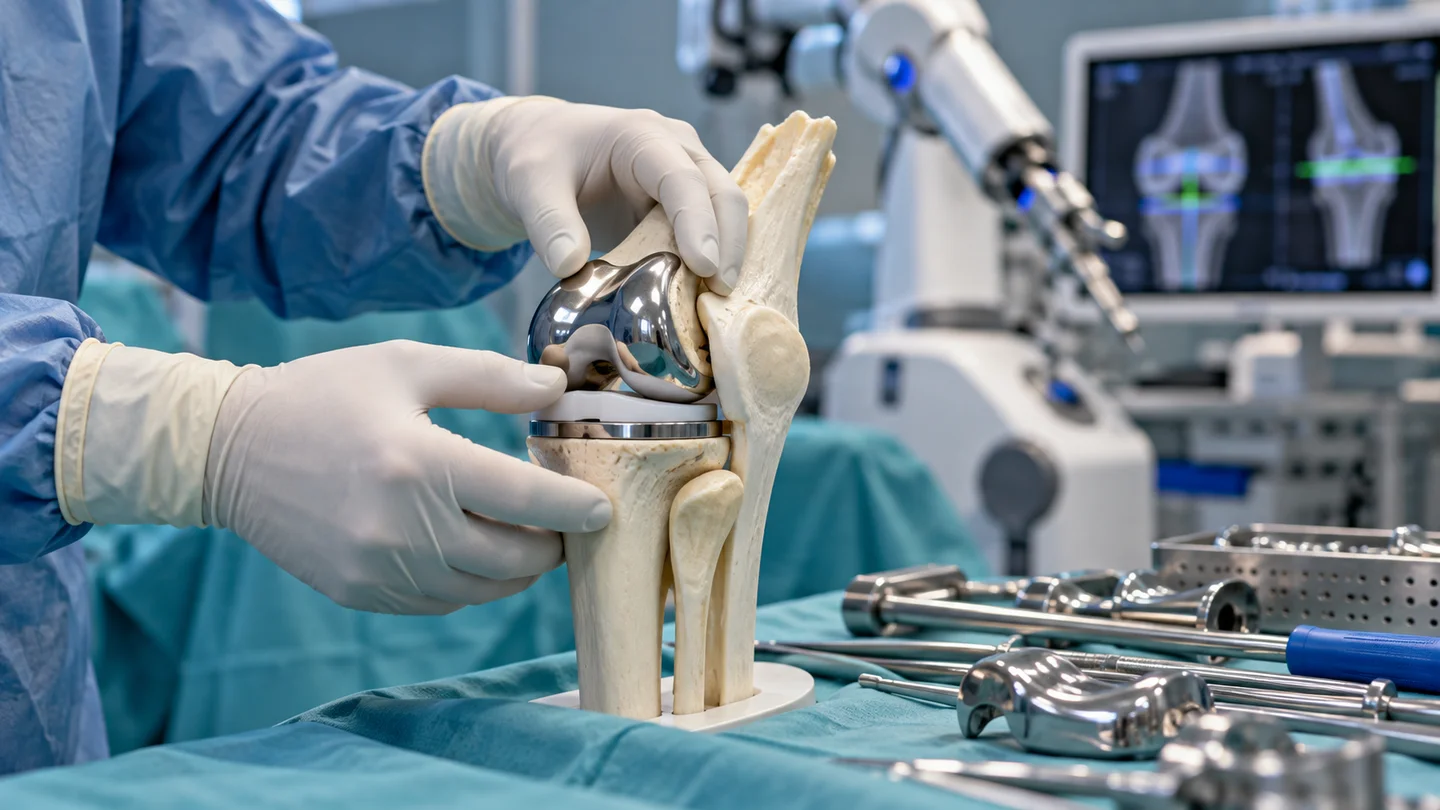

Only one side of the knee may look badly damaged on an X-ray, but that does not automatically mean a smaller operation is the right choice. In robotic knee replacement surgery, the surgeon still has to check the whole knee: the worn compartment, the other compartments, ligament stability, ACL function, deformity, stiffness, walking pattern, and long-term risk.
How does robotic knee replacement surgery planning compare partial and total options?
A partial knee replacement may be discussed when arthritis is mainly limited to one compartment of the knee. A total knee replacement may be more suitable when arthritis has spread, the knee is unstable, stiffness is significant, or the overall joint condition does not support a limited procedure.
Key decision checks include:
| Decision factor | Why it matters before choosing partial or total |
|---|---|
| Pain location | Pain should match the damaged compartment |
| X-ray pattern | Arthritis should be checked across all knee areas |
| ACL function | A limited procedure usually needs good ligament stability |
| Other compartments | Inner, outer, and kneecap-side areas must be assessed |
| Knee stiffness | Severe stiffness may change suitability |
| Deformity | Bowing or knock-knee changes alignment planning |
| Patient expectations | “Smaller surgery” still needs realistic recovery planning |
Patients comparing robotic planning for knee replacement options should have the worn compartment, ligament stability, ACL function, implant planning, alignment, and future arthritis risk reviewed together before choosing a surgical route.
The patient's concern: “Only one side is damaged, so why replace everything?”
This is one of the most practical questions patients ask.
A patient may point to the X-ray and say, “The inside of my knee is finished, but the outside looks okay.” Someone else may say the pain is mostly on one side, not the whole knee. That sounds logical. If only one side hurts, why discuss total replacement?
The answer is not always visible from one X-ray view.
The knee has different working areas. The inner side, outer side, and kneecap-side joint all share load during walking, stairs, sitting, and standing up. One area may look worst, but the surgeon still needs to check whether the remaining areas are healthy enough to carry the patient for years.
This is where the decision becomes more careful.
Partial replacement is not simply “less surgery.” Total replacement is not automatically “too much surgery.” The safer plan is the one that fits the patient’s arthritis pattern, ligament condition, alignment, and daily function.
What is unicompartmental arthritis?
Unicompartmental arthritis means arthritis is mainly affecting one compartment of the knee. The most common pattern is inner-side wear, where the patient feels pain along the medial side of the knee and may slowly develop bowing.
That does not mean every one-sided arthritis case qualifies for a partial operation.
The surgeon has to check whether the rest of the knee is genuinely healthy. The kneecap joint matters. The outer compartment matters. Ligaments matter. Knee movement matters. Pain location must match the X-ray pattern.
AAOS explains that unicompartmental knee replacement may be considered when advanced osteoarthritis is limited to a single compartment, and the damaged compartment is replaced while healthy cartilage, bone, and ligaments are preserved. Patients can read the AAOS guide on unicompartmental knee replacement for a neutral reference.
The important point for patients is simple: a partial operation requires strict selection.
Partial vs total knee replacement: what actually changes?
Partial knee replacement treats one damaged compartment. Total knee replacement resurfaces the main damaged surfaces of the knee joint more broadly.
That difference can affect bone preparation, implant design, ligament handling, alignment planning, recovery expectations, and future revision risk. But the choice is not based on size alone.
| Factor | Partial knee replacement | Total knee replacement |
|---|---|---|
| Area treated | One affected compartment | Main knee joint surfaces |
| Best fit | Arthritis limited to one area | Arthritis across multiple areas |
| Ligament requirement | ACL and key ligaments usually need to work well | Can be planned for more widespread arthritis |
| Stiffness concern | Severe stiffness may reduce suitability | May be considered in more advanced stiffness patterns |
| Deformity concern | Major deformity may be unsuitable | Broader correction planning may be possible |
| Future risk | Other compartments can worsen later | Addresses more of the diseased joint |
| Planning need | Very strict patient selection | Wider joint assessment and balancing |
A smaller operation sounds attractive, but the knee has to qualify for it. The safer choice is the one that matches the arthritis pattern, ligament condition, and long-term function.
Why does ACL function matter?
The ACL helps control stability inside the knee. If the ACL is weak, torn, or not functioning well, a limited replacement may not behave as expected.
Patients often do not know whether their ACL is healthy. They describe the problem differently.
They say the knee slips. They say it gives way on stairs. They say they do not trust it while turning. They may remember an old sports injury but never had it checked properly.
That history matters.
A partial knee replacement relies on the remaining knee structures working properly. If the knee is unstable, the surgeon has to think carefully before recommending a limited operation.
AAOS notes that patients may not be eligible for unicompartmental knee replacement if they have significant stiffness or ligament damage, and that examination includes checking knee range of motion and ligament quality. This supports why the physical examination is not optional before choosing the surgical plan.
Why do the other knee compartments matter?
The knee can mislead patients.
Pain may feel strongest on the inner side, while the kneecap joint is also worn. Or the X-ray may show one obvious damaged area, but the patient’s symptoms suggest more widespread arthritis. Sometimes stiffness and swelling say more than the pain location.
The surgeon has to match four things:
- the patient’s pain pattern
- the examination findings
- the X-ray or scan report
- the stability and movement of the knee
If these do not match, the plan should not be rushed.
For example, a patient may have severe inner-side wear but also strong kneecap pain while climbing stairs. Another may have one-sided joint space loss but a stiff, unstable knee. In such cases, replacing only one compartment may not address the full mechanical problem.
Can robotic and computer-navigated planning help compare partial and total knee replacement?
Robotic and computer-navigated planning may help the surgeon assess alignment, bone preparation, implant positioning, and compartment involvement in selected knee replacement workflows. The technology can support planning discipline, but it does not choose the operation by itself.
Patients searching for robotic knee replacement surgery in Kolkata or a robotic knee replacement surgeon in Kolkata should ask how the surgeon checks whether arthritis is truly limited to one compartment or whether total replacement is safer. The final decision still depends on examination, X-rays, ligament stability, ACL function, deformity, pain pattern, medical fitness, and surgeon judgment.
This section is important for patients comparing advanced options because technology should not be used as a label. It should answer a clinical question.
Is the damage limited? Is the knee stable? Is alignment suitable? Will the other compartments remain reliable? Does the patient understand recovery and future risk?
That is where planning matters.
Who may be unsuitable for partial knee replacement?
Some patients are not suitable for a limited procedure even when one side looks worse on X-ray.
Unsuitability may be considered when there is:
- arthritis in more than one compartment
- significant knee stiffness
- major ligament weakness or ACL damage
- severe deformity
- inflammatory arthritis affecting the joint more widely
- pain that does not match the damaged compartment
- poor bone quality or complex anatomy
- unrealistic expectations about “small surgery”
- inability to follow rehabilitation advice
This is why a knee replacement plan should not be decided only from a front-view X-ray. The whole knee has to be examined as a moving joint.
A patient may want the smallest possible operation. That is understandable. But a smaller procedure that does not match the knee can create disappointment later.
When is total knee replacement more appropriate?
Total replacement may be more appropriate when arthritis affects several compartments, the knee is badly deformed, stiffness is significant, pain is widespread, or non-surgical care has stopped helping.
It may also be discussed when the supposedly healthy compartments are not healthy enough.
AAOS describes total knee replacement evaluation as including medical history, knee motion, stability, strength, alignment, X-rays, and sometimes blood tests or advanced imaging. Patients can review the AAOS page on total knee replacement for broader context.
A recommendation for total replacement should not be seen as failure to offer a smaller option. Sometimes it is the more complete plan for the actual knee condition.
The patient deserves a clear explanation either way.
How should patients in Kolkata approach this decision?
Patients comparing robotic joint replacement surgery in Kolkata should not focus only on whether advanced technology is available. A useful consultation should explain why partial or total replacement is being considered, how the compartments are checked, whether the ACL is functional, and how the surgical plan is matched to the patient’s knee.
People searching for robotic orthopedic surgery in Kolkata may see broad claims around precision and faster recovery. Those claims should not replace a proper knee-specific discussion. The patient should understand how alignment, ligament stability, compartment wear, implant position, and recovery planning are assessed.
For patients searching for robotic and computer navigated joint reconstruction doctors in Kolkata, the practical standard is clarity. The doctor should explain what is being planned, what the technology may assist with, and what decisions remain surgeon-led.
Dr. Manoj Kumar Khemani may be relevant for patients who need evaluation of one-sided knee arthritis, partial-vs-total suitability, stiffness, deformity, ligament stability, and surgical planning. The Heal My Bones website helps patients understand that knee replacement decisions should be based on anatomy, stability, symptoms, and long-term function together.
What should patients bring to the consultation?
A good consultation becomes easier when the patient brings the right information.
Useful items include:
- recent standing knee X-rays
- old X-rays, if available
- MRI reports, if already done
- list of pain medicines, injections, or supplements used
- physiotherapy history
- diabetes, heart, kidney, or blood-pressure reports
- history of knee injury or ligament tear
- details about where the pain is worst
- notes about stairs, walking distance, sitting, and bending difficulty
The doctor needs to know how the knee behaves in daily life. A report may show one-sided damage, but the patient’s movement and symptoms decide how strongly that finding matters.
FAQ
If only one side of my knee is worn out, do I still need total knee replacement?
Total knee replacement may still be needed if arthritis, pain, deformity, stiffness, or instability affects more than one part of the knee. The surgeon checks all compartments, ligament stability, ACL function, and whether symptoms match the X-ray pattern. Patients should ask whether the rest of the knee is healthy enough for a limited operation.
Is partial knee replacement always better because it is smaller?
Partial knee replacement is not automatically better just because it treats a smaller area. It may suit selected patients with arthritis limited to one compartment and good ligament stability, but it may be unsuitable when disease is widespread or the knee is unstable. The safest plan comes from examination, imaging, alignment review, and long-term function goals.
Why does the ACL matter before choosing partial or total knee surgery?
The ACL matters because it helps control knee stability and movement. If the ligament is damaged or the knee gives way, a one-compartment procedure may not provide the right mechanical support. Patients should tell the surgeon about slipping, instability, old sports injuries, or twisting episodes.
Can robotic planning decide whether I need partial or total knee replacement?
Robotic planning does not decide the operation by itself. It may help assess alignment, bone preparation, and implant positioning in selected workflows, but the final choice depends on the surgeon’s examination and the patient’s knee condition. Patients should ask how planning tools are used for their specific arthritis pattern.
Practical next step
If one side of the knee is badly worn, the decision should not feel rushed.
Many patients hear “partial replacement” and feel relieved because it sounds smaller. Others hear “total replacement” and worry that too much is being done. The real answer sits somewhere more practical: the surgeon has to see how the whole knee is behaving, not only where the X-ray looks worse.
A one-sided worn patch matters. But so do the ligaments, knee bend, straightening, alignment, stiffness, kneecap movement, and the patient’s daily routine.
Robotic or computer-guided planning may help in selected cases, but it is still part of a larger clinical decision. The most useful consultation is one where the patient understands why a partial or total plan is being considered, what the risks are, and how the choice fits that specific knee.
The aim is not to choose the smallest operation. The aim is to choose the safest plan for long-term movement and function.
Medical Disclaimer
This article is for general educational purposes only and should not be taken as personal medical advice, diagnosis, or treatment recommendation. Partial knee replacement, total knee replacement, robotic planning, implant selection, ACL function, ligament stability, surgical suitability, risks, recovery, and rehabilitation vary from patient to patient. Please consult a qualified orthopedic surgeon with your symptoms, X-rays, medical history, current medicines, and physical examination findings before making any treatment decision.