Can't Lift Your Arm? What Surgeons Check Before Shoulder Replacement
You reach for something on a shelf, but your arm will not go high enough. When someone supports it, the shoulder moves further than you can manage by yourself. You have already been told that the joint has arthritis, so it is natural to wonder whether the X-ray explains everything.
Difficulty lifting an arm can have more than one cause. Pain and joint stiffness may limit movement, but a damaged rotator cuff, weak deltoid muscle or a problem affecting the nerves can also contribute. Sometimes several factors are present together.
Before recommending shoulder replacement, the surgeon assesses the joint and the structures that move it. This helps clarify what the operation may address and what it may not. Replacing damaged joint surfaces does not, by itself, repair a damaged nerve.
Why Does Arm Weakness Matter Before Shoulder Replacement?
Arm weakness matters because the reason you cannot lift the arm may affect the expected benefit and the type of shoulder replacement considered. The assessment may include:
- How far you can raise the arm yourself compared with how far it moves when supported.
- Whether the deltoid muscle contracts and can help lift the arm.
- Whether the rotator cuff tendons are working or may be torn.
- Whether sensation has changed around the shoulder or upper arm.
- Whether neck symptoms or weakness elsewhere suggest a nerve problem beyond the shoulder.
- Whether additional testing is likely to clarify a finding or change the treatment plan.
These are clinical clues, not a checklist that diagnoses a problem by itself. The surgeon considers them alongside your history, examination and appropriate imaging.
When Shoulder Stiffness and Arm Weakness Look Similar
Two people may both say that they cannot raise an arm above shoulder height, yet have different movement patterns.
In one person, pain and stiffness may restrict both self-directed movement and movement when the arm is gently supported. In another, the arm may move further with assistance, but the person cannot lift it through that range independently. The second pattern may lead the clinician to assess muscle, tendon and nerve function more closely.
Doctors compare active movement, which you perform yourself, with passive movement, which the examiner assists. This comparison can offer useful information, but it cannot identify the cause on its own. A major rotator-cuff tear can also cause a substantial loss of active movement even when passive movement is better preserved.
The term pseudoparalysis is sometimes used for severe loss of active shoulder movement without true paralysis. However, a 2024 expert consensus study found that specialists do not agree on every part of how pseudoparalysis and pseudoparesis should be defined. Pain and other causes must be considered, so the term should not be used as a self-diagnosis. Read the consensus study on shoulder pseudoparalysis and pseudoparesis.
Which Nerves and Muscles Help You Lift Your Arm?
Shoulder movement depends on more than the joint surfaces. Muscles need signals from nerves that travel from the neck and shoulder into the arm.
The axillary nerve and deltoid
The axillary nerve supplies the deltoid, the muscle covering the outer shoulder that helps raise the arm. It also carries sensation from a small area over the outer shoulder. If this nerve is injured or not working normally, the deltoid may be weak; the clinical significance depends on the cause and degree of the problem.
The rotator cuff and suprascapular nerve
The rotator cuff is a group of tendons and muscles that helps move and centre the shoulder. The suprascapular nerve supplies two of these muscles, the supraspinatus and infraspinatus. A tendon tear, muscle weakness or nerve problem may affect movement in different ways, and symptoms can overlap.
This is one reason an examination may assess both muscle power and sensation. Normal feeling over the shoulder does not necessarily answer every question about muscle function, and no single finding provides a complete diagnosis.
Could Some Symptoms Be Coming From Your Neck?
Nerves supplying the shoulder and arm pass from the neck through the shoulder region. Irritation or compression of a nerve root in the neck can sometimes cause pain, tingling, numbness or weakness in the shoulder or arm. Neck and shoulder conditions may also coexist.
A systematic review of cervical spine and shoulder conditions found that symptoms can overlap and that imaging findings need to be interpreted with the history and physical examination. If symptoms or examination findings suggest a possible neck-related contribution, a clinician may assess neck movement, sensation, reflexes and strength in other parts of the arm. Read the systematic review on overlapping neck and shoulder conditions.
This does not mean that every weak shoulder is caused by a neck problem. The purpose is to avoid assuming that all weakness comes from an arthritic joint simply because an X-ray shows arthritis.
Why Deltoid Function Can Affect the Replacement Plan
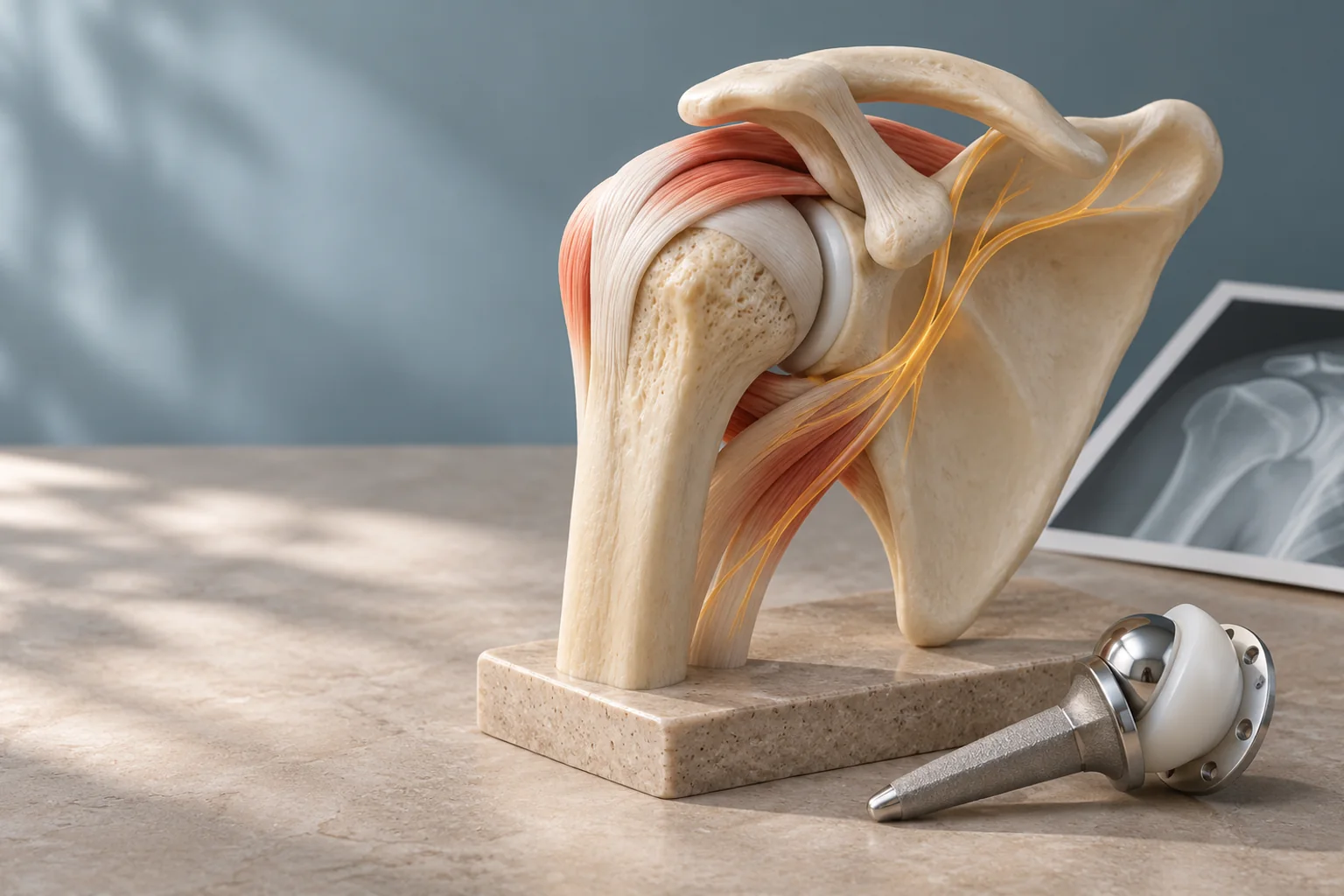
Shoulder replacement designs are not identical. An anatomic shoulder replacement broadly reproduces the natural ball-and-socket arrangement and generally relies on a functioning rotator cuff. A reverse shoulder replacement changes the ball-and-socket orientation so the deltoid can take on more of the work of raising the arm when the rotator cuff is severely damaged.
Because the deltoid is important to reverse replacement function, substantial deltoid impairment may affect whether that operation is suitable or what result can reasonably be expected. A review of reverse shoulder arthroplasty indications discusses the role of preserved deltoid contraction and the concern with severely impaired deltoid function. The evidence and surgical options continue to evolve, so this is an individual specialist decision—not a rule patients should apply to themselves. Read the review of reverse shoulder replacement indications.
Partial weakness is not the same as complete loss of function. The surgeon considers its cause, severity, duration and the condition of the joint, tendons and other muscles before discussing options.
What If the X-ray and Examination Do Not Seem to Match?
An X-ray can show joint-space changes, bone shape and other features of arthritis. It does not directly show whether the nerves supplying the deltoid are working normally.
If weakness seems greater than expected from the joint findings, or began after an injury or dislocation, the surgeon may examine the rotator cuff, deltoid and relevant nerves. Depending on the history and examination, the clinician may also consider whether a neck condition is contributing.
| Examination finding | What it may prompt the clinician to consider | Why it may matter |
|---|---|---|
| Both active and assisted movement are restricted | Joint stiffness, pain or another mechanical restriction | Helps assess how much movement may be limited by the joint itself. |
| Assisted movement is much better than active movement | Muscle, tendon or nerve dysfunction may need consideration | May lead to a closer assessment rather than attributing weakness to arthritis alone. |
| Deltoid weakness or altered sensation over the outer shoulder | Possible axillary nerve involvement | Deltoid function is relevant when reverse replacement is being considered. |
| Weakness with tingling, numbness or neck symptoms | A cervical nerve problem may be assessed | Symptoms can arise from the neck, shoulder or more than one condition. |
| Marked weakness despite arthritis on the X-ray | More than one cause may be present | Imaging and examination findings need to be considered together. |
These patterns are clues rather than definitive diagnoses. Pain, stiffness, tendon damage and neurological conditions can overlap.
What May the Surgeon Check During the Examination?
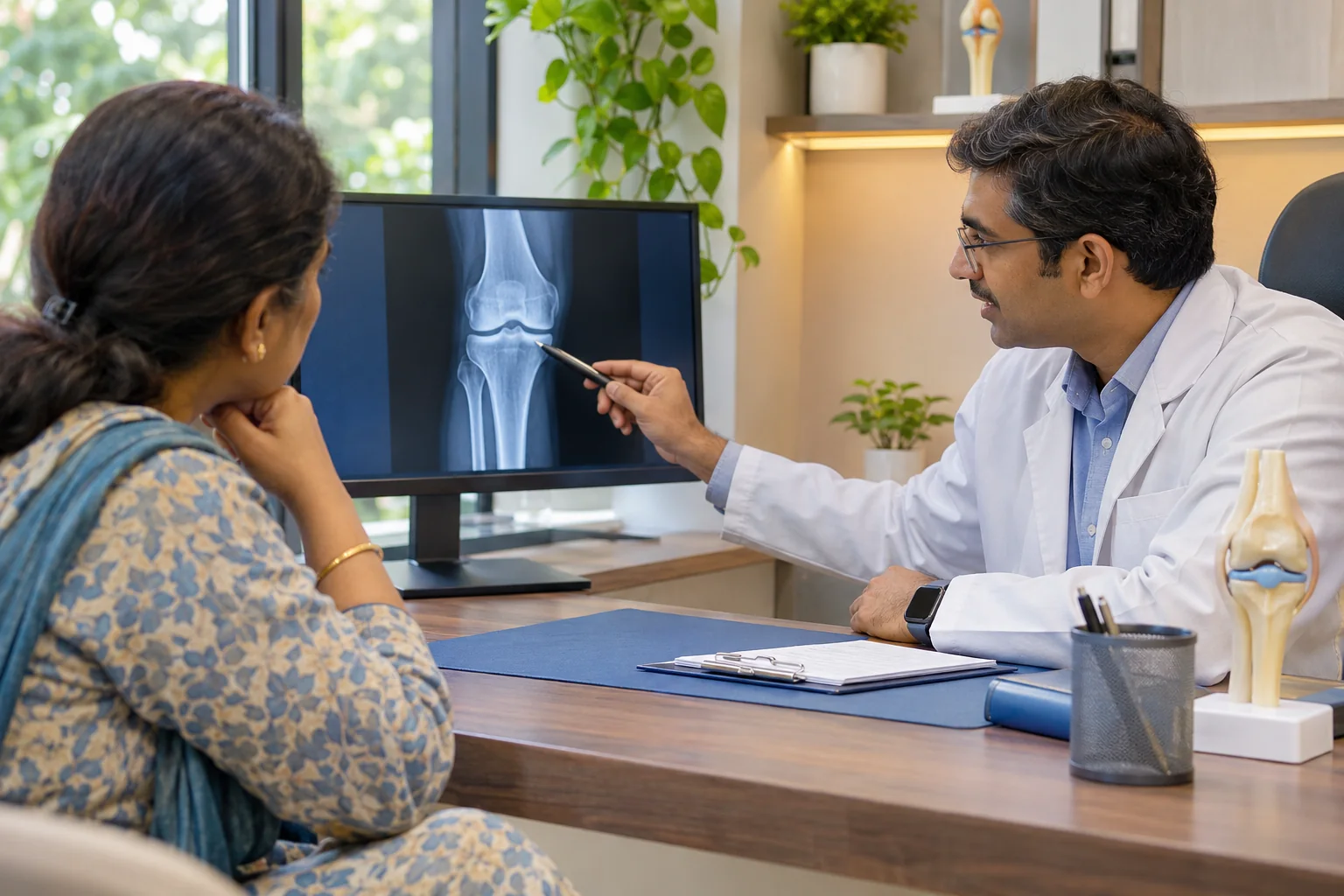
The assessment often starts by observing how you move the arm. The surgeon may ask you to raise it forward, lift it sideways or rotate it, and may compare that with movement when the arm is supported.
The clinician may assess deltoid contraction and strength, rotator-cuff function, muscle bulk and tenderness. Sensation around the shoulder and arm may also be checked. When the history suggests a possible cervical nerve problem, the examination may include the neck, other arm muscles or reflexes.
When the weakness started is useful context. Gradual limitation alongside long-standing joint pain is different from sudden weakness after a fall. Previous shoulder operations, dislocations, neck problems and changes in hand sensation should be mentioned.
When Might an EMG or Nerve-Conduction Study Be Considered?
Most people considering shoulder replacement do not automatically need specialised nerve testing. If the examination raises a specific concern, a clinician may consider electromyography (EMG), nerve-conduction studies or other investigations to help assess nerve and muscle function.
EMG records electrical activity in selected muscles. Nerve-conduction studies measure how electrical signals travel through particular nerves. These tests can provide additional information, but they do not replace a clinical assessment and may not answer every question about future function.
A prospective study of patients with rotator-cuff tear arthropathy used electrodiagnostic testing to examine axillary and suprascapular nerve findings before reverse shoulder arthroplasty. It illustrates that nerve testing can be part of a targeted assessment in selected patients; it does not mean every patient needs an EMG. Read the prospective electrodiagnostic study.
Whether a test is useful, and when it should be performed, depends on the clinical question. Your surgeon can explain whether a result would change the diagnosis, treatment options or expectations in your situation.
What If a Nerve Test Is Abnormal?
An abnormal test result does not automatically mean shoulder replacement is impossible. The clinician interprets it alongside the examination, symptoms, imaging and the muscles that matter for the proposed procedure.
Depending on the findings, the plan may remain appropriate, further assessment may be considered, or a different approach may be discussed. The implications depend on which nerve or muscle is affected and how significantly it is functioning. An EMG result should not be treated as a yes-or-no decision about surgery without clinical interpretation.
What Should You Tell the Surgeon Before Your Consultation?
Explain when the weakness started and whether it has changed. Mention any prior shoulder operation or dislocation, neck problem, injury, tingling, numbness or change in hand strength. Bring previous shoulder imaging or reports if available.
It can help to describe specific activities: Can you lift a cup, keep the arm raised while washing your hair or reach an overhead shelf? You may also ask what appears to limit movement, whether the rotator cuff and deltoid are functioning, and whether further tests would affect the treatment plan.
| What to discuss or bring | How it may help |
|---|---|
| When the weakness began and how it changed | Provides context about onset and progression. |
| Previous shoulder X-rays, reports or operations | Helps the clinician understand earlier findings and treatment. |
| Neck symptoms, tingling or numbness | May help identify symptoms that need assessment beyond the shoulder joint. |
| Specific daily tasks that are difficult | Describes the functional effect of the movement limitation. |
| Questions about the proposed implant and expected movement | Helps clarify the goals and limits of the recommended plan. |
When Arm Weakness Needs Prompt Medical Attention
New, persistent or worsening weakness, numbness or altered sensation should be discussed with a healthcare professional rather than automatically attributed to arthritis. Severe weakness or numbness after an injury also needs prompt assessment.
Sudden arm weakness, especially with facial drooping, trouble speaking or other possible stroke symptoms, is an emergency. Review the CDC's stroke warning signs and call your local emergency service immediately.
Choosing a Shoulder Replacement Surgeon in Kolkata
Patients considering shoulder replacement in Kolkata can ask how the assessment considers the joint, rotator cuff, deltoid function and any symptoms that may involve the nerves or neck. Dr. Manoj Kumar Khemani is an orthopaedic surgeon associated with HealMyBones in Kolkata.
It is reasonable to ask why a particular replacement is being considered, whether the muscles required for it are functioning adequately, whether further investigations would change the plan, and what benefits and limitations are realistic. The decision should reflect the individual's symptoms and examination—not the X-ray alone.
Before Replacing the Joint, Find Out Why the Arm Will Not Lift
Shoulder arthritis and arm weakness can occur together, but one does not always explain all of the other. Pain, stiffness, rotator-cuff problems and nerve-related weakness may overlap.
That is why an assessment before shoulder replacement considers both the joint and the structures that move it. Ask your surgeon what appears to be limiting your movement, whether additional testing is relevant and how the proposed replacement is expected to address your individual findings.
FAQ
Can shoulder arthritis make my arm too weak to lift?
Arthritis can cause pain and stiffness that make lifting difficult, but marked weakness may also involve a tendon, muscle or nerve. An examination helps the clinician assess which factors may be contributing.
Why might my surgeon check the deltoid before shoulder replacement?
The deltoid helps raise the arm and is particularly relevant to reverse shoulder replacement. If its function is significantly reduced, the surgeon may need to consider how that affects suitability and expected movement. The implications vary with the cause and degree of weakness.
Does everyone need an EMG test before shoulder replacement?
No. EMG or nerve-conduction testing may be considered if the history and examination raise a specific question about nerve or muscle function. The treating clinician decides whether a test would add useful information for that patient.
Can shoulder replacement help if I also have nerve damage?
Some people may still have treatment options, but a replacement does not directly repair a damaged nerve. The expected benefit depends on the muscles affected, the degree of nerve dysfunction, the joint condition and the proposed procedure. An individual assessment is needed.
Medical Disclaimer
This article provides general educational information and is not an individual diagnosis or recommendation for shoulder replacement.
Difficulty raising the arm can have several causes, including joint, tendon, muscle or nerve conditions. Shoulder replacement does not directly repair a damaged nerve, and improvement in movement cannot be guaranteed. Assessment and treatment decisions should be made with an appropriately qualified clinician.
Seek urgent medical care for sudden arm weakness, particularly with facial or speech changes, or for severe weakness or numbness after an injury.