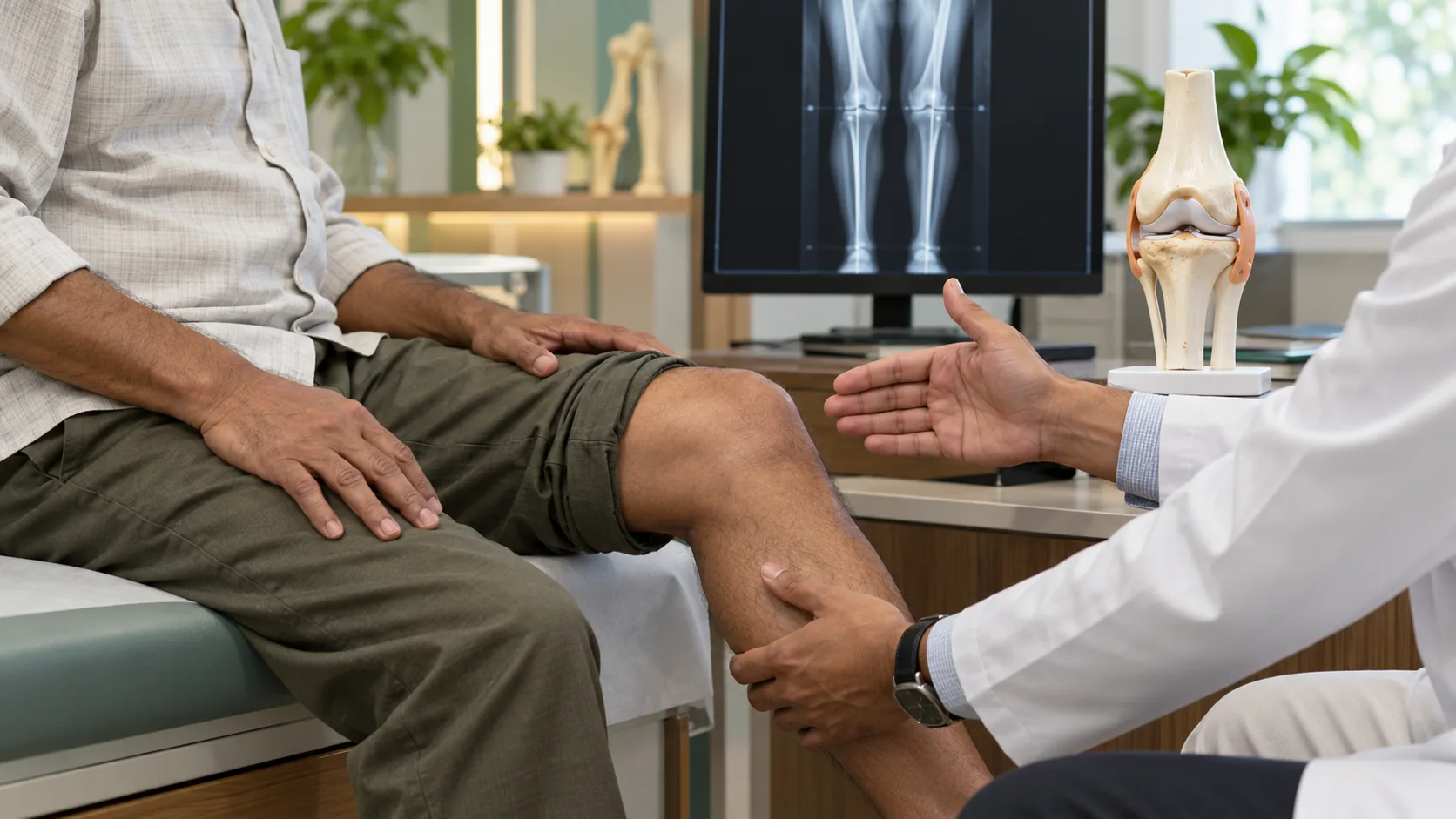
Had Knee Realignment Surgery? What Changes If You Need a Replacement?
Your knee was operated on years ago to correct its alignment. For a long time afterward, walking became easier, the pain was manageable, and you could get on with your usual activities.
Now things have changed. The knee has started hurting again, stairs are becoming difficult, and your doctor has mentioned a possible knee replacement.
But there's something you're unsure about. You still have a plate or screws from the earlier operation. Will they interfere with the new knee? And does having previous surgery make replacement more difficult?
Knee replacement after realignment surgery can require additional planning because the first operation may have changed the shape of your shinbone and the surrounding tissues.
This does not mean the earlier surgery failed. It may have helped preserve your natural knee for many years. Nor does every person who undergoes realignment eventually need a replacement.
If your knee is now significantly affected by arthritis, however, the surgeon needs to understand the old operation before planning another one.
Why Is Knee Replacement More Complicated After Realignment Surgery?
A previous knee realignment operation can change the shape of the upper shinbone, leave plates or screws in place, and create scar tissue around the joint. When knee replacement is considered later, these changes may affect bone preparation, implant positioning and the balance of the supporting ligaments.
The surgeon generally needs to assess five things:
- Bone shape: Has the earlier correction changed the upper shinbone?
- Old metalwork: Could a retained plate or screw interfere with the new implant?
- Leg alignment: How straight is the leg now, from the hip to the ankle?
- Soft tissues: Are scarring and stiffness affecting movement or access to the joint?
- Implant stability: How should the replacement components be positioned and supported?
Not everyone has all these problems. Some knees remain relatively straightforward to replace, while others require more detailed planning.
If you're considering replacement after a previous operation, understanding how robotic-assisted joint replacement is planned may help you discuss whether this approach is suitable for your anatomy.
What Did Your Earlier Knee Realignment Surgery Actually Change?
The operation you had may have been called a high tibial osteotomy, often shortened to HTO.
“Realignment surgery” can refer to different procedures involving the shinbone, thighbone or both. The exact operation matters, so check your old operation or discharge records if possible. Research specifically about HTO should not automatically be applied to every type of realignment surgery.
It is commonly performed to change how body weight passes through the knee, particularly when arthritis affects one side of the joint more than the other.
Imagine someone with a bow-legged knee and arthritis mainly on the inner side. That area receives more pressure during standing and walking.
A high tibial osteotomy changes the alignment of the upper shinbone so that some of the load shifts away from the more damaged part of the knee.
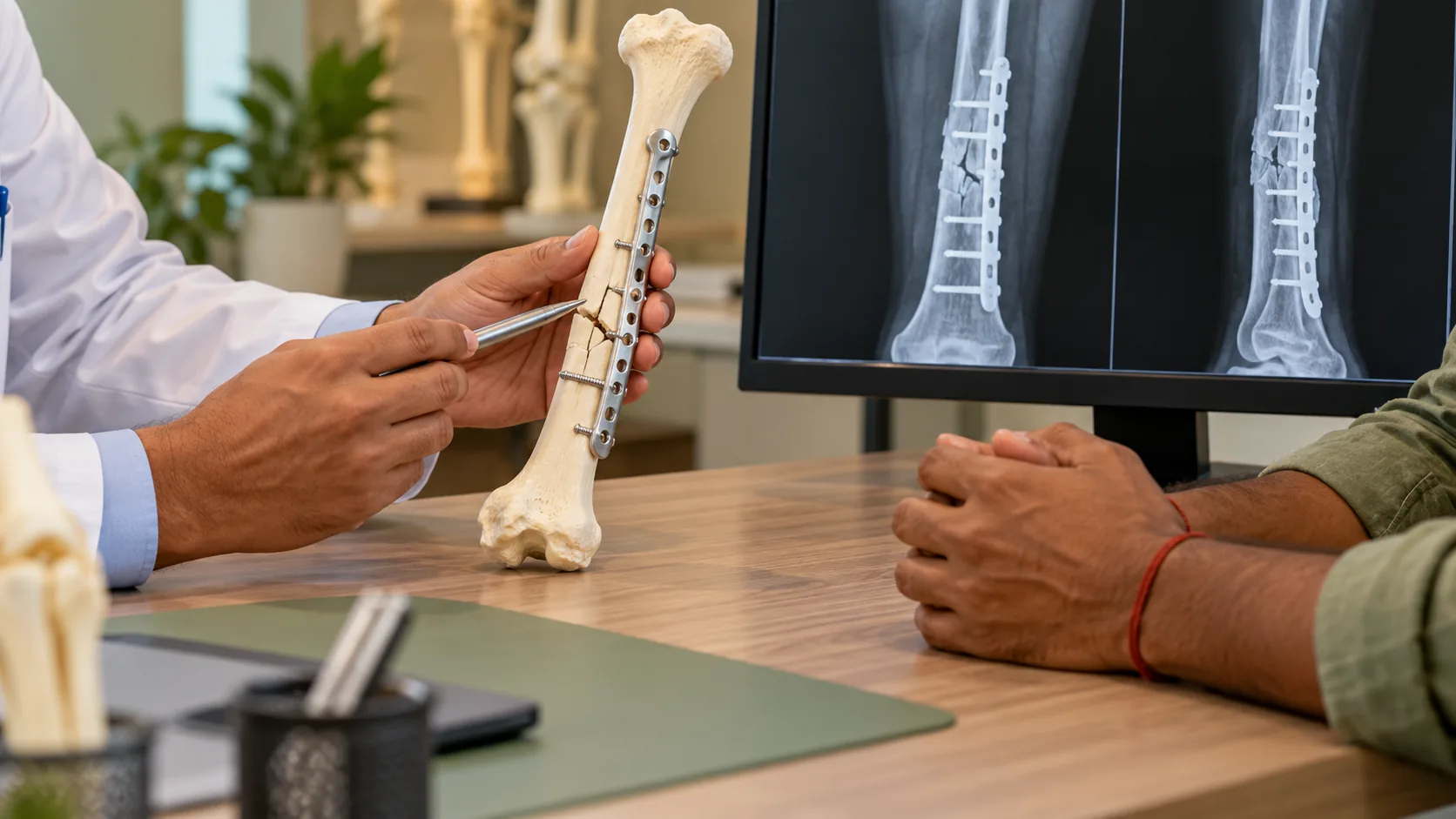
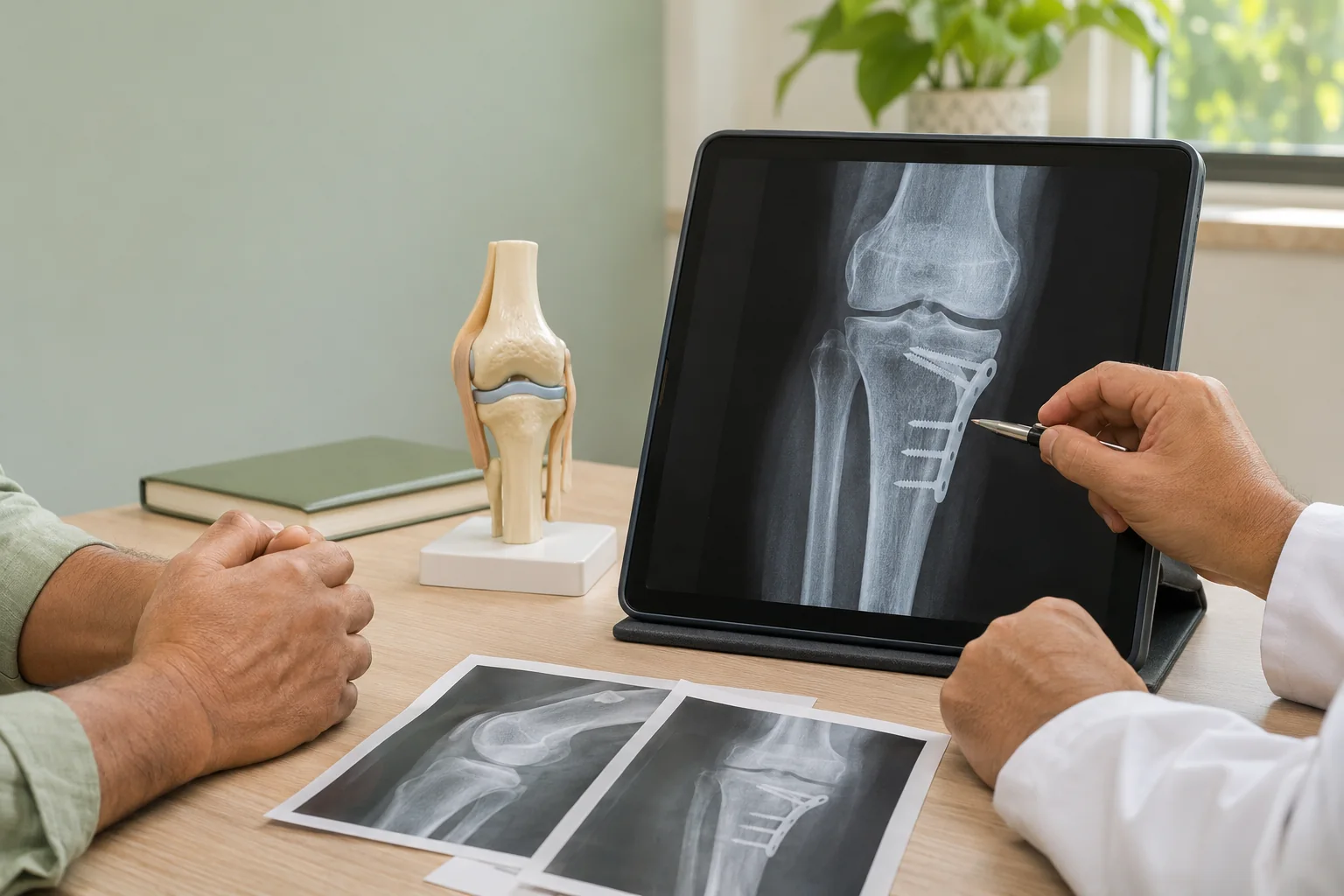
The surgeon makes a controlled cut in the bone and adjusts its position. A plate and screws may then hold the correction while the bone heals.
Unlike knee replacement, the procedure keeps the natural joint surfaces.
For selected patients, this can improve symptoms and delay the need for replacement for several years.
The American Academy of Orthopaedic Surgeons' patient guide to knee osteotomy explains how realignment can shift load away from the more affected part of the knee and notes that a later replacement may be more challenging.
The important point is that your bone was deliberately moved into a different position. Years later, the new surgeon must work with that altered anatomy.
Why Does the Shape of the Shinbone Matter During Replacement?
A knee replacement involves removing damaged joint surfaces and positioning artificial components over the prepared ends of the thighbone and shinbone.
For the components to function properly, they need suitable support from the underlying bone and an appropriate relationship with the rest of the leg.
A previous osteotomy can make this less straightforward.
The upper shinbone may no longer have its original shape
The bone above the healed osteotomy may be angled or shaped differently from a knee that has never undergone realignment.
The surgeon must take this into account when deciding where and how much bone to remove.
If the old correction is overlooked, a planned cut could remove too much bone from one area or make it harder to support the tibial component.
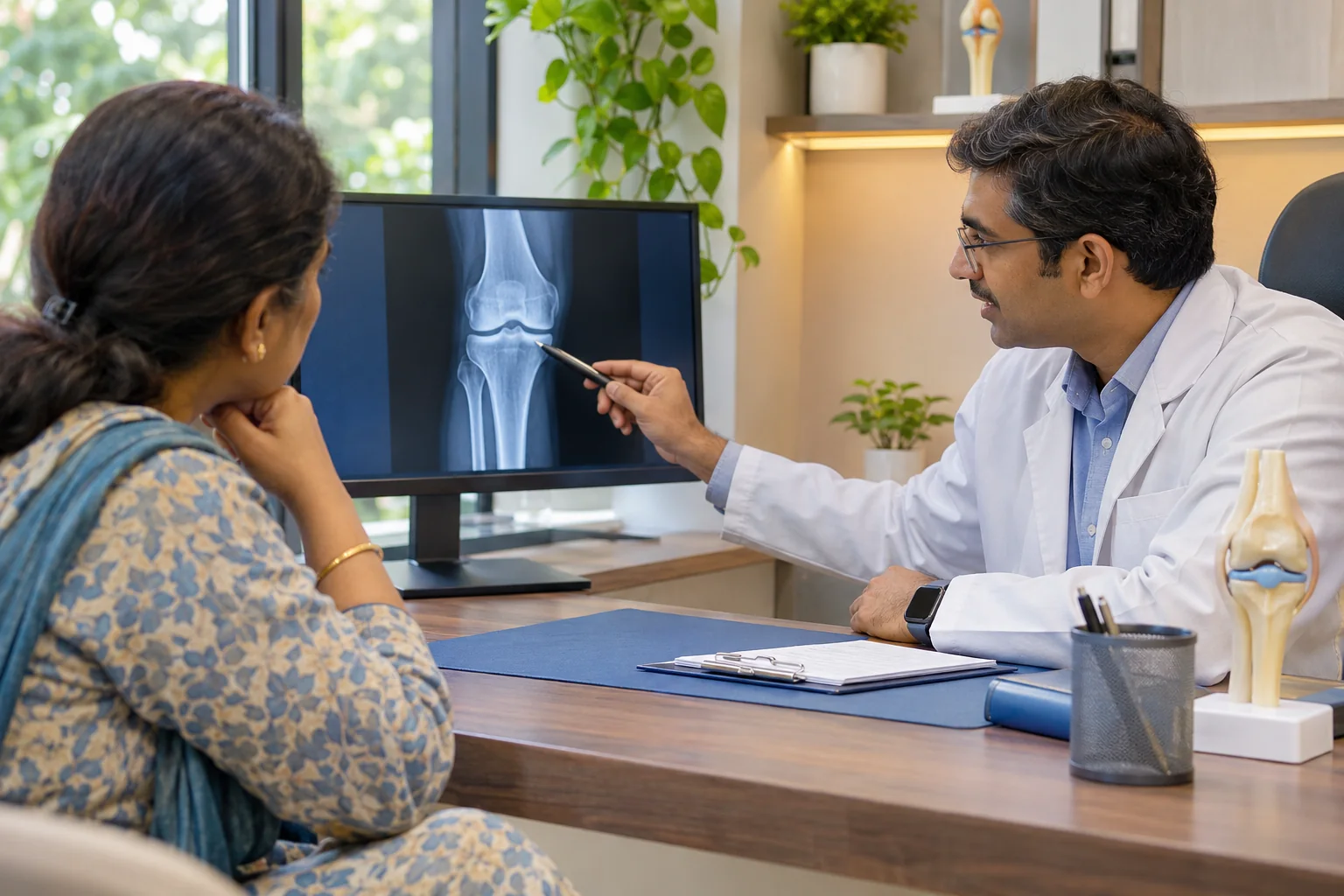
This is one reason old X-rays can be helpful. They may show how the leg was corrected, while new images show its present condition.
The slope of the knee joint may also be different
The upper surface of the shinbone has a natural backward slope when viewed from the side.
Surgeons call this the posterior tibial slope.
Some realignment operations can change that angle. The difference may not be obvious when you look at the knee from the front, but it can affect the relationship between the new components and the knee's movement.
The surgeon therefore checks both the front-to-back alignment of the leg and the shape of the bone as seen from the side.
This is a useful example of why a knee can look reasonably straight yet still require more detailed surgical planning.
Will the Old Plate or Screws Need to Come Out?
Finding metalwork on an X-ray does not automatically mean it must be removed.
The important question is where the plate and screws sit in relation to the planned replacement.
If the hardware blocks a bone cut, interferes with implant placement or prevents the use of necessary instruments, removal may be required.
But if the metalwork is not in the way and can safely remain, the surgeon may consider leaving some or all of it in place.
There are also situations where hardware removal needs additional thought.
A screw that has remained in bone for many years may be difficult to extract. Removing it can leave a hole or temporarily weaken part of the surrounding bone.
The position of the old scar and the condition of the skin may also influence the plan.
Can the hardware be removed during the replacement?
Sometimes, yes. The surgeon may remove the necessary screws or plate during the same operation.
In other situations, a separate removal procedure may be preferable. The decision depends on the hardware, bone condition, soft tissues and whether it is safe to combine the procedures.
If you still have records from the first operation, bring them to the consultation. Knowing the type of plate, the position of the screws and the original correction can be useful.
What About Scar Tissue and a Stiff Kneecap?
You may have a well-healed scar from the earlier operation and no discomfort around it.
Even then, the tissues beneath the skin may have changed.
Previous surgery can create scarring around the joint. For some patients, that reduces flexibility or makes it harder to move the kneecap during a later operation.
The position of the kneecap may also have changed. In certain cases, it sits lower than usual, a finding known as patella baja.
This does not happen after every osteotomy, but it matters when present.
During knee replacement, the surgeon needs enough access to prepare the bone and position the implant without unnecessarily damaging the surrounding tissues.
A stiff knee or restricted kneecap movement can make that part of the operation more demanding.
The physical examination should therefore assess more than pain and arthritis.
It should also consider how far the knee bends and straightens, how freely the kneecap moves, and where the previous incisions were made.
How Do Surgeons Recheck Alignment and Ligament Balance?
The old realignment procedure changed how weight passed through the knee. Arthritis and years of movement may have produced further changes since then.
That means the leg's present alignment may not be identical to the correction achieved during the first operation.
The surgeon must assess where the leg stands now and how stable the joint feels during movement.
Ligaments are part of that assessment.
The tissues on the inner and outer sides of the knee help prevent excessive sideways movement. They also influence how the artificial joint feels when bending, straightening and bearing weight.
If one side is unusually tight or the other side is too loose, the replacement may not function as intended.
This is what surgeons mean by ligament balancing.
The goal is to achieve suitable stability and movement without creating unnecessary tension in the surrounding tissues.
In some patients, the surgeon can achieve this using a standard implant arrangement. Others may require a different approach because of significant instability, bone loss or deformity.
An old osteotomy does not automatically mean a special implant will be needed.
Ordinary Knee Replacement vs Replacement After Realignment
The differences become easier to understand when the two situations are compared.
| What is assessed | Knee without previous realignment | Knee after previous osteotomy |
|---|---|---|
| Upper shinbone | Usually retains its original shape | May have altered angles or bone geometry |
| Plates and screws | Usually absent | May still be present |
| Bone preparation | Planned around current joint anatomy | Must also account for the healed correction |
| Previous scars | No osteotomy incision | Old incisions may affect surgical access |
| Kneecap movement | Influenced by current knee condition | May additionally be affected by scarring or altered position |
| Ligament balance | Assessed around the arthritic joint | May also reflect earlier alignment changes |
| Implant planning | Based on current anatomy and stability | May require additional assessment of hardware, bone shape and stability |
This comparison does not mean every knee replacement after osteotomy is difficult.
A patient with good movement, sound bone and no interfering hardware may need relatively few modifications to the usual plan.
Another patient with marked deformity, stiff tissues and retained implants may require a more complex reconstruction.
The individual findings make the difference.
Can Robotic Assistance Help After an Earlier Realignment Operation?
When the shape of the shinbone has changed, planning the new implant can be more demanding.
Some robotic-assisted knee replacement systems help the surgeon create a detailed plan based on the patient's anatomy. Depending on the system, information may come from a CT scan, measurements collected during surgery or a combination of methods.
This can help assess alignment, guide component positioning and, in selected cases, identify where old hardware may interfere with the plan.
But robotic assistance has limits.
It cannot remove scar tissue on its own, determine whether old screws are safe to retain or independently resolve every problem involving ligament stability.
Evidence specifically involving knee replacement after osteotomy remains limited. A single-centre retrospective comparison of 90 patients reported more accurate radiographic alignment and component positioning with robotic assistance, but did not find a statistically significant difference in postoperative Knee Society Scores. The authors called for larger studies and longer follow-up. These results do not prove that a robot improves pain, recovery or long-term implant survival for an individual patient. Read the published comparative study.
The surgeon remains responsible for reviewing the anatomy, selecting the implant, checking the reliability of the plan and making decisions during the operation.
Robotic technology is an aid to surgical planning and execution, not a guarantee of a better result.
If you're researching a robotic knee replacement surgeon in Kolkata, ask how the proposed technology would account for your earlier correction and whether it offers a practical advantage for your knee.
Is Knee Replacement Riskier After a Previous Osteotomy?
Previous knee realignment can introduce additional technical challenges, but it does not mean a later replacement is destined to fail.
A 2025 systematic review and meta-analysis comparing total knee replacement after high tibial osteotomy with primary total knee replacement reported broadly comparable survival and clinical outcomes, but a higher pooled complication rate in the post-osteotomy group. These are group-level findings from the included studies, not a prediction of what will happen to one person. See the published review and its methods.
The risks for any particular person depend on the old operation, current bone condition, range of movement, other medical conditions and the procedure being planned.
A surgeon may need to consider wound problems, stiffness, instability, bone defects, infection and implant-related complications.
The purpose of careful planning is to identify the challenges before surgery and address them where possible.
Which Records Should You Bring to Your Consultation?
If you had your knee realigned ten or fifteen years ago, you may not remember exactly which procedure was performed.
That's understandable.
Even so, a few documents can make the assessment more informative.
Your previous-surgery checklist
| What to bring | How it helps |
|---|---|
| Old operation or discharge records | Identifies the original procedure and correction |
| Previous X-rays | May show the earlier alignment and hardware position |
| Recent knee X-rays | Shows current arthritis and the healed osteotomy |
| Standing full-leg X-rays, if already available | Helps assess alignment from the hip to the ankle |
| Details of retained plates or screws | Helps identify possible implant or instrument interference |
| Current medication and medical history | Supports preoperative risk assessment |
The surgeon may request additional standing X-rays or other imaging if the existing records do not answer the necessary planning questions.
A CT scan is sometimes helpful, but it is not automatically required for every patient.
If your original operative records are unavailable, that does not prevent an assessment. Current imaging and examination can still provide substantial information.
Does Everyone Eventually Need Replacement After Knee Realignment?
No.
An osteotomy may continue to provide satisfactory function for many years. Some people never develop symptoms severe enough to justify knee replacement.
Others experience progression of arthritis despite the earlier correction.
The decision to consider replacement should be based on the knee's present condition.
For example, an X-ray may show significant arthritis, but the person may still walk comfortably and manage everyday activities.
Someone else may struggle with short distances, experience persistent pain and have substantial stiffness despite appropriate non-surgical treatment.
Those two situations do not call for the same recommendation simply because both patients previously had an osteotomy.
The earlier operation is relevant to planning. It is not, by itself, a reason to replace the joint.
When Should You Seek a Knee Replacement Assessment in Kolkata?
If you underwent realignment surgery years ago and now experience persistent knee pain, worsening stiffness or increasing difficulty walking, an orthopaedic evaluation can help establish what has changed.
It may be progression of arthritis, but the source of symptoms should not be assumed without examination.
Dr. Manoj Kumar Khemani, associated with HealMyBones in Kolkata, provides orthopaedic and joint replacement consultations.
At HealMyBones, the discussion of a previously operated knee should be informed by the patient's current symptoms, imaging findings and relevant surgical history.
Whether conventional or robotic-assisted replacement is considered, the central question remains the same: what approach is appropriate for the joint as it exists today?
FAQ
Does everyone who had knee realignment eventually need a replacement?
No. An earlier osteotomy may provide satisfactory function for years, and some people never need a replacement. The decision depends on the current symptoms, examination, imaging and overall health—not the history of realignment alone.
Will the old plate and screws always have to be removed?
No. Removal is not automatic. The surgeon assesses whether the hardware interferes with bone cuts, implant placement or instruments, and whether removal can be performed safely during the replacement or should be staged separately.
Does robotic knee replacement guarantee a better result after an osteotomy?
No. Limited research in this specific situation reports improved radiographic accuracy in one retrospective comparison, without a statistically significant difference in postoperative knee scores. A robot cannot resolve every issue involving scar tissue, hardware or ligament balance, and it does not guarantee pain relief or longer implant life.
Does previous realignment mean my replacement will have complications?
No single result applies to everyone. A 2025 review found a higher pooled complication rate after replacement following high tibial osteotomy, while survival and clinical outcomes were broadly comparable with primary replacement. Those group findings cannot predict an individual's risk, which should be discussed with the treating surgeon.
Does research on high tibial osteotomy apply to every realignment operation?
No. The cited outcome review specifically concerns high tibial osteotomy. Other realignment procedures may change different parts of the leg, so the original operation and current anatomy need to be assessed individually.
What should I bring to an appointment about replacement?
Bring the previous operation or discharge records, old and recent X-rays, details of any retained hardware, and a list of current medicines and relevant medical history if available. The surgeon can advise whether further imaging is needed.
Your Old Knee Surgery Is Part of the New Plan
If knee realignment helped you avoid replacement for years, that period of improved function still matters.
Now, if pain and arthritis have progressed, the previous operation becomes an important part of planning the next treatment.
The surgeon needs to understand how the shinbone was repositioned, whether the old metalwork affects implant placement and whether scarring or ligament changes influence stability.
Some patients need only limited changes to a standard replacement plan. Others require more detailed assessment and reconstruction.
Before making a decision, gather your old records if available, have your current knee and leg alignment assessed, and ask how the earlier operation may affect surgery and rehabilitation.
A replacement should be recommended because your current condition justifies it—not simply because you underwent realignment years ago.
Medical Disclaimer
This article is intended for general educational purposes only and does not provide an individual diagnosis or recommendation for knee replacement surgery.
Treatment decisions depend on symptoms, examination findings, imaging, previous surgical history and overall health. Conventional and robotic-assisted knee replacement both involve risks, and no technique guarantees a particular outcome or recovery period.
Consult an appropriately qualified orthopaedic surgeon for an individual assessment. Seek urgent medical attention for a serious knee injury, sudden inability to bear weight, fever with a hot swollen joint or other concerning acute symptoms.