More Than One Knee Ligament Torn? Why Surgery Is Different
A torn ACL is a familiar injury, especially among people who play football, cricket or other sports involving sudden changes in direction. But what happens when the ACL isn't the only ligament damaged?
A serious fall, road accident or forceful twisting injury can sometimes damage two, three or even all four major ligaments that help hold the knee stable.
These are called multiple knee ligament tears, or multi-ligament knee injuries.
They aren't simply more severe versions of an ordinary ACL tear. The knee may lose stability in several directions, and the injury can sometimes involve nearby nerves or blood vessels.
That is why treatment begins with understanding the full extent of the damage—not immediately deciding which ligament should be reconstructed first.
What Makes Multiple Knee Ligament Tears Different From an ACL Injury?
A multi-ligament knee injury occurs when two or more of the knee's major stabilising ligaments are damaged. Unlike an isolated ACL tear, which mainly affects certain forward and rotational movements, combined ligament injuries can make the knee unstable in several directions and may accompany a knee dislocation.
Doctors assess three concerns early:
- Knee stability: Which ligaments have torn, and how much abnormal movement is present?
- Circulation and nerve function: Are the blood vessels and nerves near the knee working normally?
- Associated damage: Are the meniscus, cartilage, bones or surrounding tissues also injured?
Not every combined tear requires the same operation. Some ligament injuries can be managed without reconstruction, while other patterns require surgery to restore sufficient stability.
Patients looking into how knee ligament injuries are assessed and treated can review the available approaches before discussing their individual findings with an orthopaedic specialist.
The key difference is that the surgeon must assess how the damaged structures affect one another.
Four Ligaments, Four Different Jobs
Think about what happens when you step off a pavement, turn suddenly or walk down stairs.
Your knee doesn't simply bend and straighten. It also needs to resist unwanted sliding, twisting and sideways movement.
Four major ligaments work together to provide that control.
| Ligament | Full name | Main stabilising role |
|---|---|---|
| ACL | Anterior cruciate ligament | Restrains excessive forward movement of the shinbone and helps control rotation |
| PCL | Posterior cruciate ligament | Restrains excessive backward movement of the shinbone |
| MCL | Medial collateral ligament | Resists excessive inward collapse, or valgus stress, at the inner side of the knee |
| LCL | Lateral collateral ligament | Resists excessive outward opening, or varus stress, at the outer side of the knee |
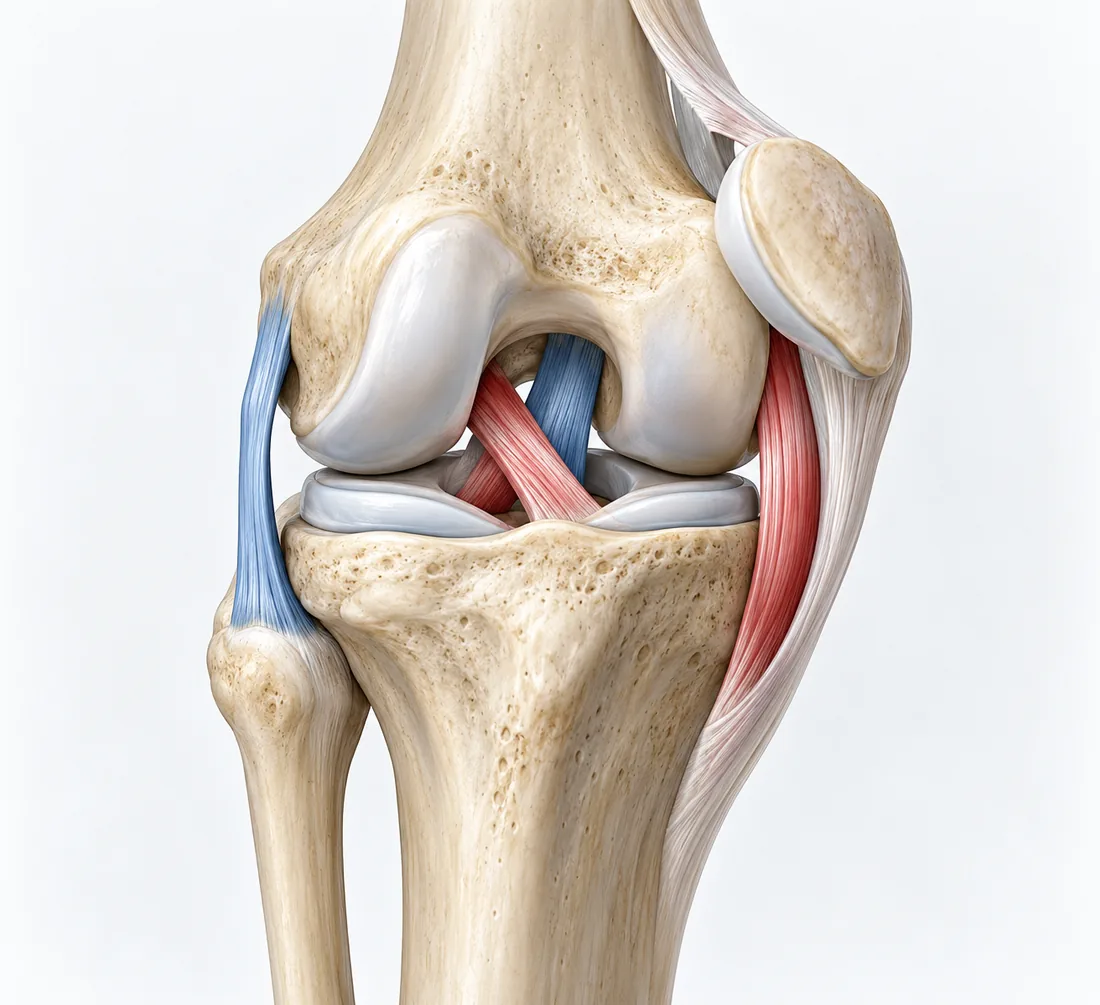
These ligaments don't work independently.
For example, an ACL injury may produce instability during sudden turns. If a side ligament is also torn, the knee can become unstable during sideways loading.
An ACL and PCL injury together may allow abnormal movement in both forward and backward directions.
The outer side of the knee is especially complex. An LCL injury may occur alongside damage to other structures in the posterolateral corner, which help control sideways opening and rotation.
Missing that additional damage can affect treatment planning.
This is why an MRI report listing several torn ligaments needs more than a quick count of injuries.
The surgeon must understand which stabilising functions have been lost.
Why Can a Multi-Ligament Injury Be an Emergency?
One of the most serious concerns isn't the ligament tear itself.
It is what may have happened to the structures behind and around the knee.
A major injury can force the thighbone and shinbone out of their normal relationship. This is called knee dislocation.
Sometimes the knee moves back into place before the patient reaches the hospital.
The leg may therefore look relatively normal even though a serious injury has occurred.
Behind the knee runs the popliteal artery, an important blood vessel supplying the lower leg.
A dislocation can stretch or damage this artery. The nearby nerves, particularly the common peroneal nerve, may also be injured.
A patient may notice numbness, weakness or difficulty lifting the foot.
Why checking the foot pulse isn't always enough
A warm foot with a detectable pulse is reassuring, but it does not completely rule out an arterial injury.
Some blood-vessel damage may initially be difficult to detect, and circulation can change after the injury.
For suspected knee dislocation or a serious multi-ligament injury, doctors assess foot pulses, skin colour, temperature, sensation and muscle function.
They may also measure the ankle-brachial index (ABI), which compares blood pressure at the ankle with blood pressure in the arm.
An abnormal result, concerning examination findings or significant clinical suspicion may lead to urgent CT angiography to examine the arteries.
The clinical review Management of Multiligament Knee Injuries discusses the importance of early neurovascular assessment and the risks associated with knee dislocation.
This is why a suspected severe multi-ligament injury should not be treated as a routine sports injury without proper assessment.
If a serious knee injury is followed by a cold or pale foot, absent or reduced pulses, new numbness, marked weakness or rapidly worsening pain, seek emergency medical care immediately.
Do not attempt to force a visibly displaced knee back into position yourself.
How Does a Surgeon Find Out Which Ligaments Are Torn?
A patient may arrive with a swollen knee, considerable pain and difficulty putting weight on the leg.
A detailed ligament examination can be difficult immediately after a major injury.
Pain and swelling may limit movement, while an unstable knee must be handled carefully.
The first assessment prioritises circulation, nerve function, joint position and associated injuries.
X-rays help identify fractures or abnormal joint alignment.
An MRI may then provide detailed information about the ACL, PCL, collateral ligaments, meniscus and other soft tissues.
The surgeon also uses carefully selected physical examination tests to assess instability in different directions.
For example, the knee may be examined for excessive forward or backward movement and abnormal opening at the inner or outer side.
However, MRI findings alone do not determine treatment.
A partially torn ligament may still provide useful stability. Another ligament that appears less dramatic on imaging may cause substantial functional instability.
The examination findings, injury mechanism and patient's needs all influence the treatment plan.
Why Isn't Reconstructing Every Torn Ligament the Automatic Answer?
When an MRI shows several ligament tears, it is understandable to assume that every ligament needs an operation.
That isn't always the case.
Some partial injuries may heal sufficiently with appropriate bracing and rehabilitation. Certain collateral ligament injuries can also be treated without reconstruction, depending on their severity and associated instability.
Other structures may be unlikely to provide adequate stability without surgery.
A surgeon therefore considers which ligaments need repair, reconstruction or non-operative care.
The distinction between repair and reconstruction also matters.
Ligament repair involves reattaching or suturing suitable injured tissue in selected circumstances.
Ligament reconstruction involves using a graft to replace or recreate the function of a damaged ligament.
Not every tear is suitable for direct repair.
The injury's location, tissue quality, time since injury and combination of damaged structures help determine the approach.
The aim is not necessarily to operate on the greatest number of ligaments. It is to restore appropriate stability while minimising unnecessary tissue damage and complications.
Why Might Several Grafts Be Needed During Surgery?
A single ACL reconstruction generally addresses one ligament.
A multi-ligament injury may require reconstruction of several structures with different stabilising functions.
For example, a patient with complete ACL and PCL tears may require separate grafts to reconstruct both ligaments.
If important stabilisers on the inner or outer side of the knee are also severely damaged, additional repair or reconstruction may be considered.
A graft is tissue used to create a replacement ligament.
It may come from the patient's own tissue, called an autograft, or from donated tissue, called an allograft, depending on availability, suitability and the surgical plan.
The grafts must be positioned and secured in ways that reproduce the required ligament functions.
This can make surgery more demanding.
The surgeon must consider the relationship between the grafts, the directions in which they stabilize the knee, their fixation and how tension is balanced.
There are also practical questions: how much suitable graft tissue is available, whether more than one incision is required and how the reconstruction will affect rehabilitation.
Using more grafts does not automatically mean a better result.
The correct strategy depends on the structures that genuinely require reconstruction.
Why Are Some Multi-Ligament Operations Performed in Stages?
Patients sometimes expect all the torn ligaments to be reconstructed during one operation.
That may be appropriate for selected injuries, but it isn't always the safest approach.
A severe knee injury can produce substantial swelling, bruising, damaged skin or associated fractures.
The knee may also be very stiff or difficult to move.
Operating on every damaged structure immediately may not be appropriate when the soft tissues are in poor condition or when blood-vessel injuries require urgent attention.
In some situations, the medical team first addresses the urgent injury, protects the knee and allows surrounding tissues to recover before definitive ligament reconstruction.
This is known as staged treatment.
In other cases, a planned single-stage reconstruction may be suitable.
There is no universally correct timetable for every multi-ligament injury.
The clinical practice guidance on multiple ligament knee injuries explains how the timing and approach depend on factors such as vascular status, associated fractures, soft-tissue condition and the specific ligaments damaged.
Delaying part of the reconstruction does not necessarily mean the injury is being neglected.
It can reflect a deliberate decision to address the most urgent problems first and plan the remaining surgery around the condition of the knee.
Is Recovery Different From Ordinary ACL Surgery?
Often, yes.
Rehabilitation after a multi-ligament reconstruction can be more restrictive than rehabilitation after an isolated ACL procedure.
The main reason is that several repaired or reconstructed structures may need protection at the same time.
For example, exercises or movements that are appropriate for one ligament graft may place unwanted stress on another.
Weight-bearing restrictions and the use of a brace depend on the procedure and associated injuries.
Some patients need to limit knee movement during particular stages of healing. Others can begin carefully controlled movement earlier.
The rehabilitation plan must balance two competing concerns.
Too much stress too soon may compromise healing tissues.
Too little movement for too long may contribute to stiffness and muscle weakness.
Progress is therefore based on the reconstruction performed, tissue healing, knee control and clinical assessment—not simply a standard calendar.
Recovery can extend over many months, and returning to demanding sports may take considerably longer.
Some patients experience persistent stiffness, weakness or instability despite appropriate treatment. Return to pre-injury sport or activity cannot be guaranteed.
What Complications Do Surgeons Watch For?
A complex ligament injury can affect more than joint stability.
Complications may arise from the original trauma, the reconstruction or the rehabilitation period.
One concern is arthrofibrosis, where excessive scar tissue contributes to stiffness and reduced movement.
Other possible problems include infection, blood clots, ongoing instability, graft failure, nerve symptoms and persistent pain.
An associated cartilage or meniscal injury can also influence longer-term joint health.
Even after successful stabilisation, some patients may develop post-traumatic osteoarthritis over time.
That does not mean every patient will develop arthritis. It means serious knee trauma can affect the joint beyond the immediate ligament tears.
Regular follow-up helps the treating team monitor stability, movement, strength and possible complications.
The rehabilitation programme may need adjustment if stiffness or other symptoms develop.
When Should You Consult a Knee Ligament Specialist in Kolkata?
A knee that repeatedly gives way after an injury needs assessment.
So does a knee that remains markedly swollen, unstable or difficult to bear weight on after a significant twisting injury or accident.
People sometimes assume that an injury is improving because the initial pain has settled.
Pain reduction is welcome, but it does not necessarily mean the damaged ligaments have regained their stabilising function.
An orthopaedic examination can help identify whether more than one ligament may be involved and whether additional investigations are required.
At HealMyBones, Dr. Manoj Kumar Khemani provides orthopaedic consultations for knee ligament injuries in Kolkata.
The purpose of assessment is to establish the injury pattern and determine whether bracing, rehabilitation, repair or reconstruction is appropriate.
For a suspected knee dislocation, circulation problems, new nerve symptoms or severe trauma, emergency hospital assessment must come before a routine specialist appointment.
A Stable Knee Needs More Than One Ligament Working Properly
An isolated ACL injury and a knee with several torn ligaments may share symptoms such as swelling, pain and instability.
But the injuries can require very different decisions.
With multiple damaged ligaments, the surgeon must consider movement in several directions, associated injuries, blood supply, nerve function and the possibility of more than one reconstruction.
Sometimes, certain ligaments can be managed without surgery. In other cases, several grafts or staged procedures may be necessary.
The most useful step is to establish exactly what has been injured before deciding on a treatment plan.
If your knee feels unstable after a serious injury—or an MRI shows damage to more than one ligament—seek an appropriate orthopaedic assessment and ask how the complete injury pattern affects treatment and rehabilitation.
FAQ
Can someone walk with both the ACL and PCL torn?
Yes, some people can still walk after tearing both the ACL and PCL. However, the knee may be severely unstable, and walking does not rule out a serious associated injury, including damage to blood vessels or nerves. A suspected combined injury needs prompt medical assessment, especially after a forceful accident.
Can a knee dislocate and go back into place by itself?
Yes, a dislocated knee can sometimes return to its normal position spontaneously. Even when the knee looks aligned afterward, serious ligament, blood-vessel or nerve damage may remain. A suspected knee dislocation requires emergency evaluation rather than waiting for a routine appointment.
Can multiple knee ligaments heal without surgery?
Some combined ligament injuries can be managed without reconstructing every damaged ligament. The decision depends on the specific structures injured, the severity of instability, associated damage and individual functional requirements. A specialist assessment helps determine which structures may heal adequately with bracing and rehabilitation.
Is multi-ligament knee surgery more complicated than ACL reconstruction?
Yes, reconstructing several ligaments is generally more complex than treating an isolated ACL tear. Multiple grafts, different directions of instability, associated injuries and competing rehabilitation requirements can make planning and recovery more demanding. The treating surgeon should explain which structures need reconstruction and how each will be protected during rehabilitation.
Medical Disclaimer
This article is intended for general educational purposes and does not replace individual medical advice, diagnosis or treatment. Multi-ligament knee injuries vary significantly, and treatment decisions depend on the examination, imaging, circulation, nerve function, associated injuries and overall health.
Surgery and rehabilitation involve risks, and no particular result or recovery timeline can be guaranteed.
A suspected knee dislocation or severe injury involving a cold or pale foot, new numbness, significant weakness or rapidly worsening pain requires immediate emergency medical attention.